How · Yours
How to buy seafood without pretending one label knows everything
A trustworthy seafood decision is rarely made from one green logo or one word like ‘wild’. Start with identity, then build the answer through origin, production method, local management, handling and your own needs.
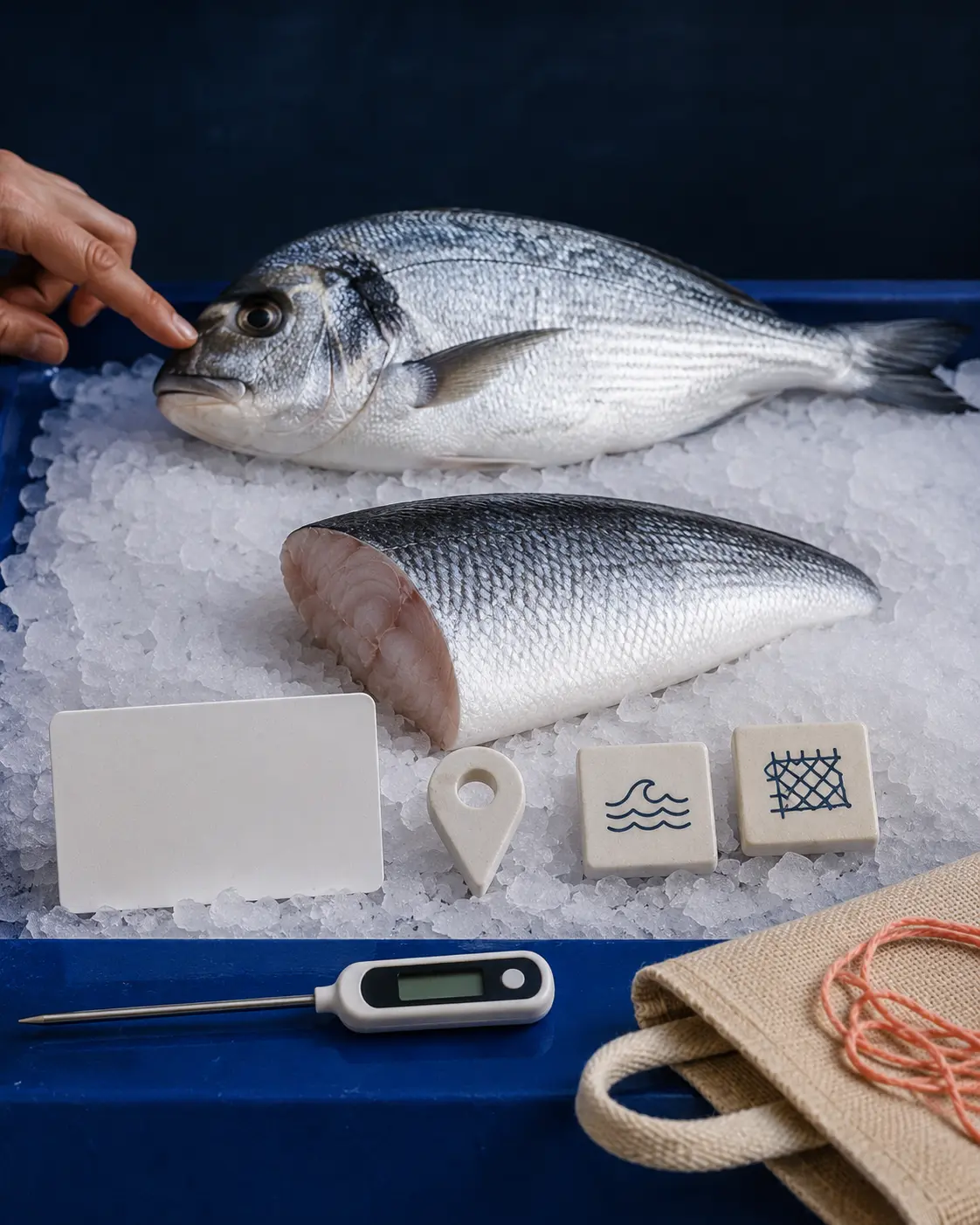
Begin before the badge
Write down the species, origin and production method. If the seller cannot provide them, you cannot reliably connect the item to a stock assessment, farm practice or certification scope.
Wild is not automatically better than farmed; local is not automatically lower impact; fresh is not automatically safer or higher quality than properly frozen.
Read certification like evidence
FAO’s ecolabelling guidance emphasizes voluntary, transparent and credible schemes with sound assessment and procedures. Ask which fishery or farm is certified and whether chain-of-custody information follows the product.
A badge may address environmental management without covering every labour, welfare, climate or nutrition question.
- Exact certified unit.
- Current certificate or listing.
- Chain of custody.
- Clear scope and exclusions.
Finish with the household decision
Check storage temperature, odour, texture, packaging, use-by information and local food-safety advice. Plan a quantity you will cook and eat.
If the evidence is incomplete, choose a transparent alternative, a different species or a non-seafood meal. Responsible buying includes the freedom not to force the purchase.
Before you decide
Keep these five things with you.
- 01Name the species
- 02Confirm origin and method
- 03Check label scope
- 04Inspect handling and storage
- 05Buy only what you will use
How this story earns trust
Sources, method and relationship—visible.
Each reference is tagged by the geography and authority of the source—not by the reader’s location. A country tag means the evidence is country-specific; it is never presented as a global rule.
Method
The guide does not rank species globally. Fisheries and farms must be assessed in their local management and supply-chain context.
Commercial relationship
Independent editorial. No seafood seller, certification scheme or restaurant paid for inclusion.
Correction or improvement
Found a mistake, a missing perspective or a source we should review? Send it to the editorial desk ↗
- 01The State of World Fisheries and Aquaculture 2026 ↗
Food and Agriculture Organization of the United Nations. Current global evidence on fisheries and aquaculture production, resources and food systems.
- 02Guidelines for the Ecolabelling of Fish and Fishery Products from Marine Capture Fisheries ↗
Food and Agriculture Organization of the United Nations. Principles and minimum criteria for voluntary fisheries ecolabelling.
If this made you pause, pass the blue forward.
How to buy seafood without pretending one label knows everything
Ready to share
Made for personal and editorial sharing with Eight June attribution. Facts are shortened for the card; the article carries the full context, method and sources.
Questions readers ask next
Three sourced answers
to keep close.
What is the shortest answer?
Ask what species it is, where it came from, whether it was caught or farmed and how. Use certification as one evidence layer, then consider freshness, food safety, price and whether the claim applies to that exact product.
Which evidence is carrying the answer?
The evidence trail names The State of World Fisheries and Aquaculture 2026, Guidelines for the Ecolabelling of Fish and Fishery Products from Marine Capture Fisheries. Open those records for their exact scope, geography, definitions and update dates.
What should I carry into the decision?
The page’s checklist highlights these points: Name the species; Confirm origin and method; Check label scope; Inspect handling and storage. Use the linked sources to confirm any detail that changes by place, provider or date. The editorial information on this page was last reviewed on 1 September 2026. Time-sensitive conditions, prices, rules and availability should still be confirmed at the linked source on the day they matter.