What · Essence
What makes a glass sponge an animal rather than a piece of glass?
The intricate framework is mineral, but the organism that builds and uses it is alive.
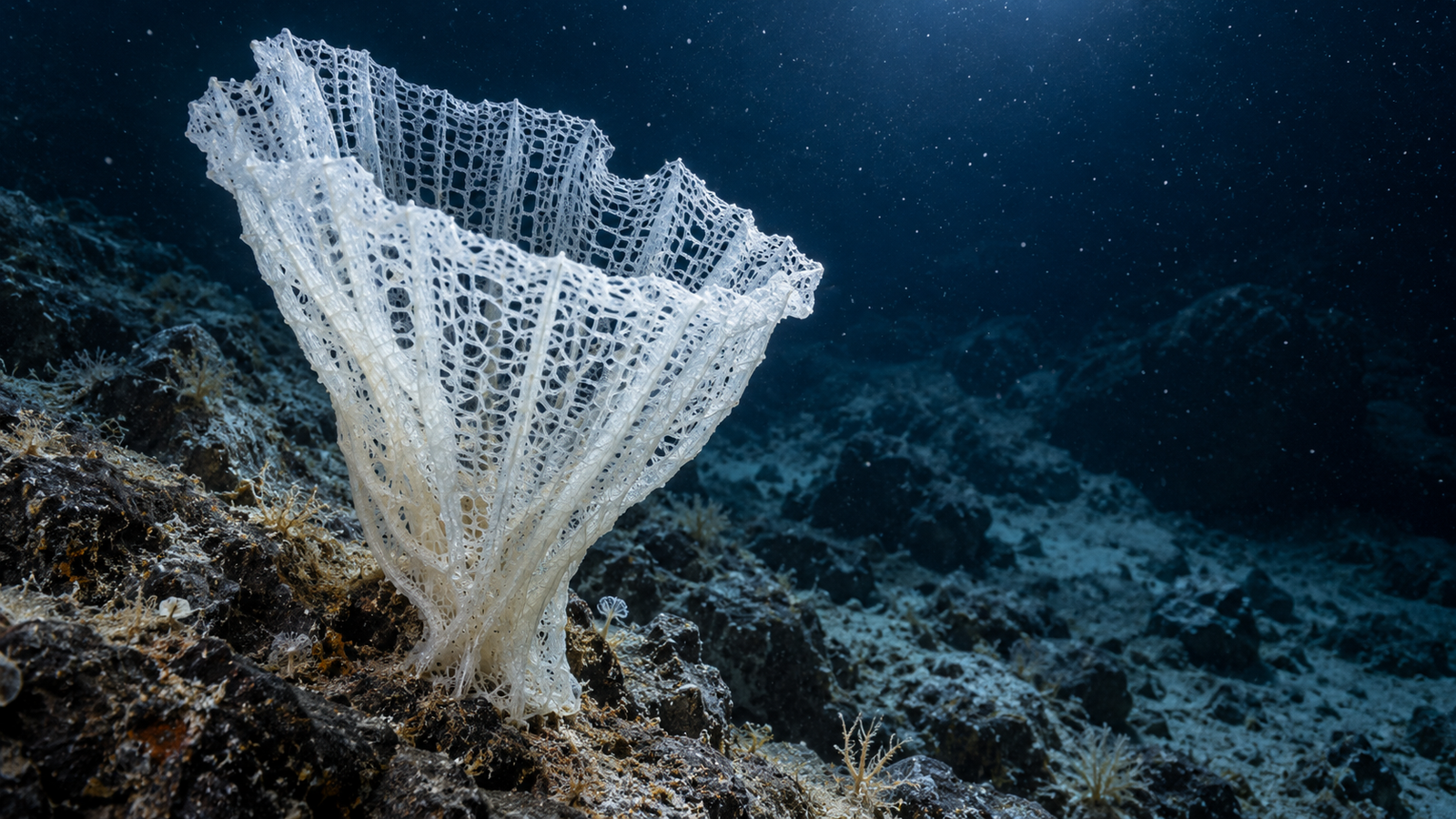
Glass-like material gives the group its name
NOAA places glass sponges in the class Hexactinellida. Silica spicules support the animal, and in some species these elements form an elaborate interconnected framework. The visible lattice can resemble an engineered object, but it was produced by a living organism.
Water flow connects the animal to its food
Many glass sponges remain attached to hard surfaces and feed on bacteria and small plankton from surrounding water. NOAA Ocean Exploration explains that sponges depend on water moving through their bodies for food and oxygen. They are not plants relying on leaves or roots.
The seafloor links biology with geology
NOAA's Voyage to the Ridge material connects glass-sponge communities on volcanic pillow basalts with silica-based skeleton building. A deep-sea scene can therefore record both the substrate on which animals live and the minerals incorporated into their bodies.
A skeleton can outlast its builder
Some glass-sponge frameworks remain intact after death. A still photograph of a lattice alone may not reveal whether living tissue remains. Use the expedition's identification and observation notes rather than assigning a species or condition from appearance.
Before you decide
Keep these five things with you.
- 01Use the expedition's identification when available.
- 02Distinguish the mineral framework from living tissue.
- 03Avoid assigning a species from one photograph.
- 04Keep location and depth tied to the source observation.
- 05Do not describe a specimen as alive or dead without supporting information.
How this story earns trust
Sources, method and relationship—visible.
Each reference is tagged by the geography and authority of the source. Country-specific evidence is never presented as a global rule.
Method
Researched and drafted by AI using the cited primary sources, then read back as a separate editorial review. The latest main source, existing daily packages and published WordPress title/slug inventories were screened. This catch-up publication covers a missed daily slot; the publication date shown is the actual publication date. The illustration is AI-generated and does not document a real observation.
Commercial relationship
Independent editorial information. Any affiliate links or paid placements will be clearly labelled where they appear.
Correction or improvement
Found a mistake, a missing perspective or a source we should review? Send it to the editorial desk ↗
- 01NOAA Ocean Service — What is a glass sponge? ↗
NOAA. Primary source supporting the article; checked 18 October 2026.
- 02NOAA Ocean Exploration — Sponge diversity ↗
NOAA. Primary source supporting the article; checked 18 October 2026.
- 03NOAA Ocean Exploration — Pillow basalts and glass sponges ↗
NOAA. Primary source supporting the article; checked 18 October 2026.
If this made you pause, pass the blue forward.
What makes a glass sponge an animal rather than a piece of glass?
Ready to share
Made for personal and editorial sharing with Eight June attribution. Facts are shortened for the card; the article carries the full context, method and sources.
Useful questions
Quick answers,
kept specific.
Are all sponges made of glass-like silica?
No. Sponges have diverse forms and supporting structures; this article concerns glass sponges.
Can other animals use their skeletons?
NOAA describes glass-sponge structures as habitat for other animals.