What · Pulse
What makes Australia’s east-coast Akoya pearls distinct
The story of Akoya cultured pearls is not confined to Japan and China. GIA documented a native New South Wales oyster, a sheltered farm system in eastern Australia and a locally developed cultivation record that should be read precisely rather than turned into a blanket quality claim.
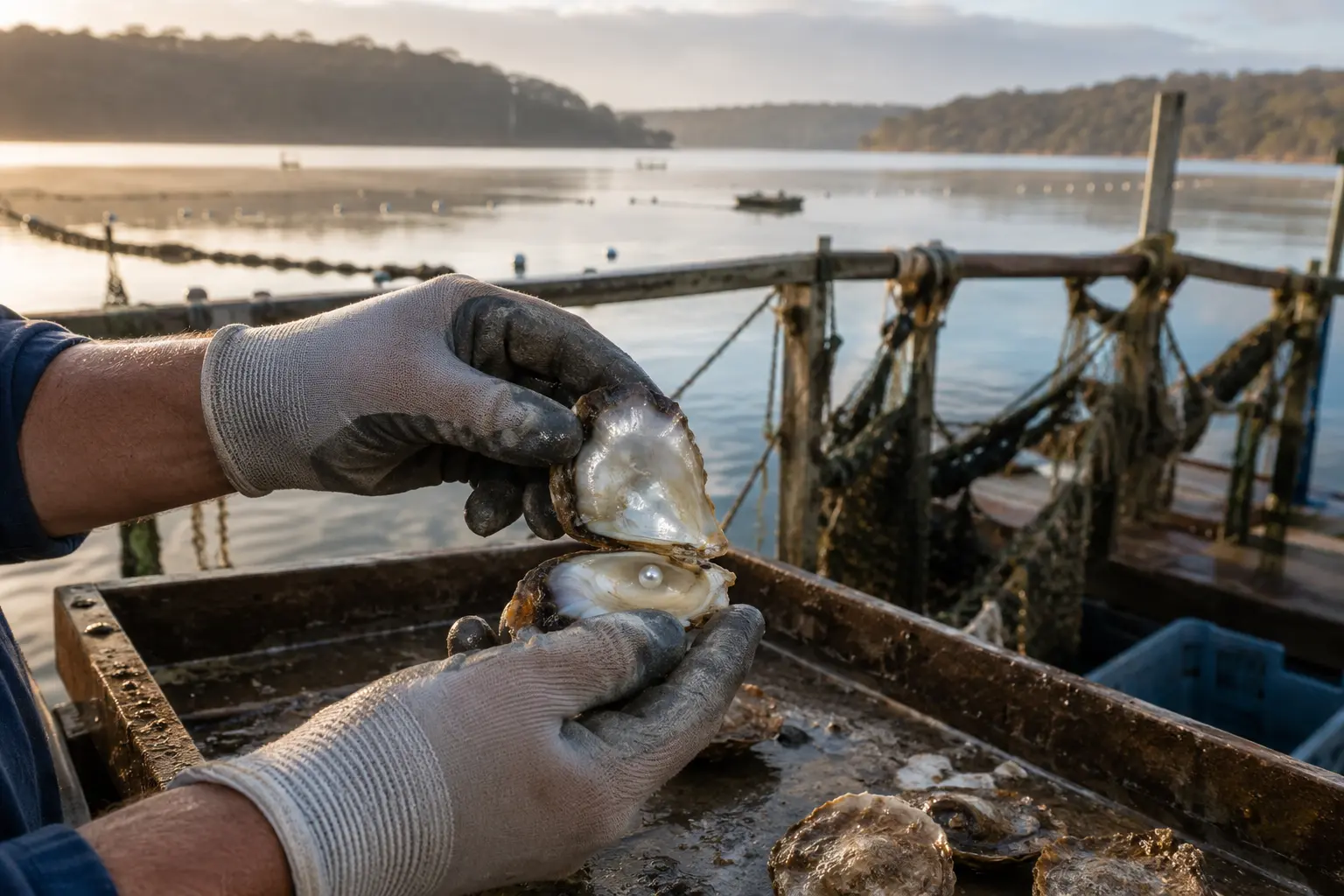
The identity begins with species and place
GIA’s 2017 study identifies the pearl oyster as Pinctada imbricata fucata, native to the New South Wales coast. The farm studied was near Woy Woy in a sheltered estuarine setting rather than in Australia’s better-known north-western South Sea pearl region.
That distinction matters. “Australian pearl” can refer to different species, coasts and production systems. A useful description should name the pearl family, the producing mollusc when known, the farm or region and the evidence carrying the origin claim.
Documented history: a newer Akoya branch on an older pearling map
GIA reports Akoya production on Australia’s eastern shoreline from approximately 1999 and says Broken Bay Pearls had been culturing Akoya pearls since 2003. The research describes hatchery support, juvenile growth in mesh systems and repeated husbandry before seeding and harvest.
The same paper contrasts this Akoya activity in eastern Australia with Australia’s long-established South Sea pearl production from Pinctada maxima. It does not erase Japanese Akoya history; it documents an additional regional production story.
Present position: research record and visitor operation must stay separate
The GIA paper is a dated scientific study of material and production practice. It reported an 18-month growth period and pearls marketed without dye or bleach in that study context. Those findings should not be silently extended to every current item.
Pearls of Australia’s current Broken Bay page describes a working farm, a Shellar Door, guided experiences and locally grown Akoya pearls near the lower Hawkesbury. Opening hours, tours, stock and product claims remain controlled by the operator and should be rechecked directly.
- Use the scientific paper for the documented 2017 study
- Use the farm site for current visitor and commercial information
- Ask for item-specific treatment and origin disclosure
- Do not convert a regional story into a universal quality grade
The genuine opportunity is better origin language
For buyers, the opportunity is a more precise question: not simply “Is this Australian?” but “Which species, which coast, which farm, what treatment disclosure and what product evidence?” For visitors, a working-farm experience can connect an object to husbandry, water and time.
Eight June’s interpretation is that this east-coast record broadens Akoya geography while making careful attribution more important. Neither GIA nor the farm source asks readers to treat origin as a substitute for independent product assessment.
Before you decide
Keep these five things with you.
- 01Confirm Akoya rather than South Sea identity
- 02Name the farm or producing region
- 03Request item-specific treatment disclosure
- 04Check the current farm page before visiting
- 05Keep origin separate from quality and ethics
How this story earns trust
Sources, method and relationship—visible.
Each reference is tagged by the geography and authority of the source. Country-specific evidence is never presented as a global rule.
Method
This Pulse article combines GIA’s gemmological study of Akoya farming in eastern Australia with the current Broken Bay Pearl Farm visitor page. The scientific record, present commercial information and Eight June interpretation are kept separate.
Commercial relationship
Independent editorial. Neither Pearls of Australia, GIA nor any pearl seller paid for inclusion. The farm is a commercial producer and visitor operation.
Correction or improvement
Found a mistake, a missing perspective or a source we should review? Send it to the editorial desk ↗
- 01Akoya Cultured Pearl Farming in Eastern Australia ↗
GIA · Gems & Gemology. Species, location, cultivation history, study methods and dated findings.
- 02Broken Bay Pearl Farm ↗
Pearls of Australia. Current visitor location, hours, experiences and operator claims; recheck before visiting or buying.
If this made you pause, pass the blue forward.
What makes Australia’s east-coast Akoya pearls distinct
Ready to share
Made for personal and editorial sharing with Eight June attribution. Facts are shortened for the card; the article carries the full context, method and sources.
Useful questions
Quick answers,
kept specific.
Are Akoya pearls produced only in Japan and China?
No. GIA documented Akoya cultured-pearl farming on Australia’s New South Wales coast using native Pinctada imbricata fucata.
Does Australian origin prove a pearl is untreated?
No. GIA reported findings for the production and samples studied. A current item needs its own treatment disclosure or report.
Can Broken Bay Pearl Farm be visited?
Its official page currently lists a visitor location and guided experiences. Recheck hours, departures and availability directly before travel.