Where · Compass
Where is the Sargasso Sea if it has no coastline?
The Sargasso Sea sits in the North Atlantic without land borders. Discover the moving currents that frame it, the floating Sargassum habitat within it and why its location matters.
A sea surrounded by water, not land
Most people find a sea by tracing the coastline around it. The Sargasso Sea asks for a different map: NOAA places it entirely in the Atlantic Ocean, within the North Atlantic subtropical gyre.
The Gulf Stream marks its western side; the North Atlantic Current, Canary Current and North Atlantic Equatorial Current complete the broad circulation around it. This description locates an ecological region, not a fenced polygon with a permanent edge.
Why a current can act like a boundary
A gyre is a large circulation system. In this part of the North Atlantic, currents and winds help gather and redistribute floating material, including Sargassum. The ocean moves continually, so any drawn outline of the Sargasso Sea is an approximation suited to a particular purpose.
NOAA describes the region by the currents around it. For navigation, conservation or research, use the relevant official map and its stated geographic definition rather than assuming one universal boundary.
The golden habitat that gave the sea its name
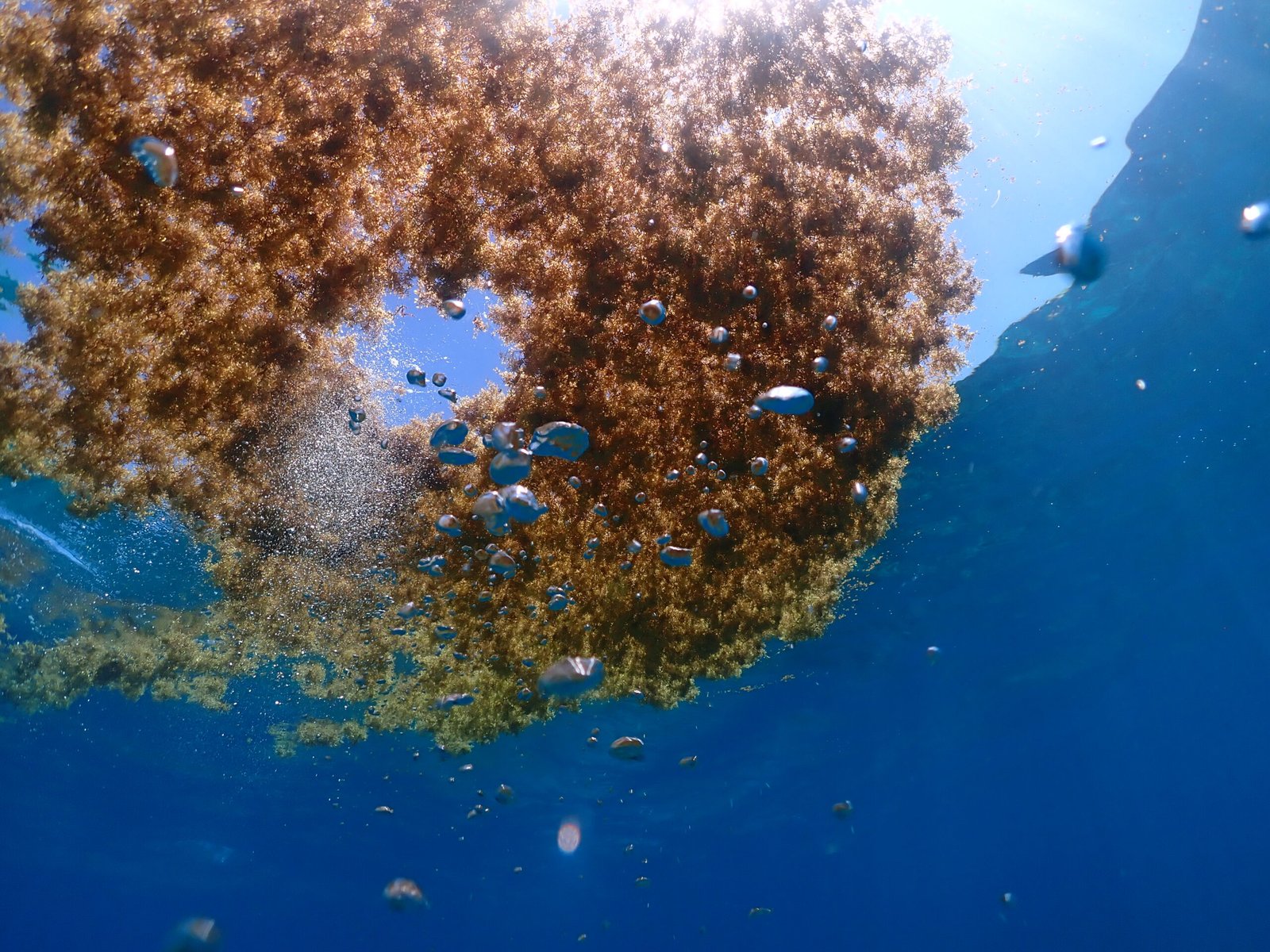
The region is known for holopelagic Sargassum, free-floating brown algae that remain in the open ocean through their life cycle. Floating mats create a three-dimensional shelter in an otherwise exposed surface habitat.
NOAA identifies nursery habitat for young sea turtles and living space for fish, shrimp and crabs associated with the algae. The Sargasso Sea Commission likewise describes Sargassum as a foundation of this pelagic ecosystem.
The surprising connection to eels
The Sargasso Sea is recognised as the only known spawning region for the American and European eel species described by the Sargasso Sea Commission. These eels have life histories connecting distant continental waters with the Atlantic.
This does not mean every eel seen in a river comes from a single fixed point. It means that a remote open-ocean region plays a crucial reproductive role in species whose lives extend far beyond it.
Sargassum elsewhere is not the Sargasso Sea
Floating Sargassum can also occur far beyond the region, including Caribbean and Florida waters. A beach covered with seaweed does not establish that the beach lies within the Sargasso Sea.
The accompanying underwater photograph shows floating Sargassum near Florida and is used to illustrate the habitat-forming algae, not to claim a photograph of the Sargasso Sea itself.
Why its geography matters
The Sargasso Sea Commission identifies pressures from shipping, fishing, plastic pollution and climate change. Much of the region is high seas, so stewardship involves cooperation across institutions rather than a single coastal authority.
When reading a Sargasso Sea story, separate three things: the physical current-bounded region, the organisms that depend on it, and the specific area used by any conservation initiative.
Before you decide
Keep these five things with you.
- 01Locate the North Atlantic subtropical gyre before looking for a Sargasso Sea outline.
- 02Identify the Gulf Stream, North Atlantic Current, Canary Current and North Atlantic Equatorial Current as its broad surrounding flows.
- 03Remember that currents move, so the sea's ecological boundaries are not permanent coastlines.
- 04Distinguish floating Sargassum seen elsewhere in the Atlantic from a photograph taken within the Sargasso Sea.
- 05Check which official geographic definition a research or conservation map uses before comparing areas.
How this story earns trust
Sources, method and relationship—visible.
Each reference is tagged by the geography and authority of the source. Country-specific evidence is never presented as a global rule.
Method
AI-assisted editorial research reviewed NOAA's official Sargasso Sea explanation and the Sargasso Sea Commission's ecosystem account, then checked current GitHub catalogues and 21 dated packages for topic, organisation and image duplication. The public WordPress REST inventory endpoints could not be retrieved; manual-only live additions remain unconfirmed. Image provenance, licence, dimensions and direct raster rendering were checked on Wikimedia Commons.
Commercial relationship
Independent informational editorial. Neither NOAA nor the Sargasso Sea Commission nor the image creator sponsored, endorsed or paid for this article; no affiliate relationship is represented.
Correction or improvement
Found a mistake, a missing perspective or a source we should review? Send it to the editorial desk ↗
- 01Marine Protected Areas: Sargasso Sea ↗
NOAA. Current-bounded location, four major surrounding currents, free-floating Sargassum and marine nursery habitat.
- 02The Sargasso Sea ↗
Sargasso Sea Commission. Open-ocean ecosystem, Sargassum habitat, eel spawning, conservation context and institutional stewardship.
If this made you pause, pass the blue forward.
Where is the Sargasso Sea if it has no coastline?
Ready to share
Made for personal and editorial sharing with Eight June attribution. Facts are shortened for the card; the article carries the full context, method and sources.
Useful questions
Quick answers,
kept specific.
Is the Sargasso Sea a country or a coastal bay?
No. It is an open-ocean region of the North Atlantic, characterised by currents and floating Sargassum rather than a land coastline.
Which currents surround the Sargasso Sea?
NOAA identifies the Gulf Stream, North Atlantic Current, Canary Current and North Atlantic Equatorial Current as its broad bounding flows.
Does all Atlantic Sargassum come from the Sargasso Sea?
No. Sargassum also occurs elsewhere in the Atlantic and Caribbean; the algae's presence alone does not define the Sargasso Sea.
Why do marine biologists care about this region?
Floating Sargassum provides nursery and shelter habitat for several marine species, and the region is linked to the spawning of American and European eels.