Where · Compass
Where to experience bioluminescence—with care
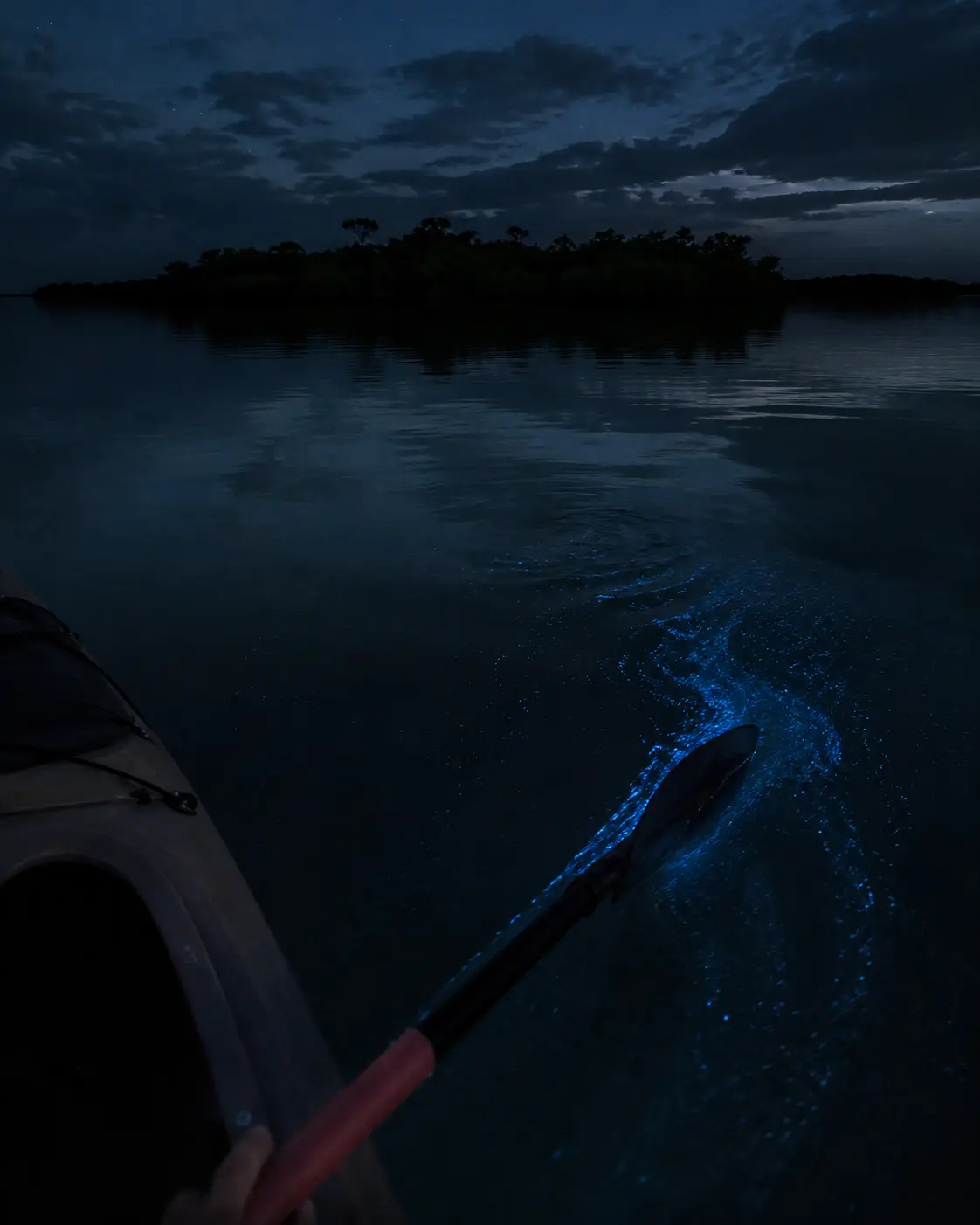
Bioluminescent water can feel impossible: every paddle stroke waking blue-green light. The phenomenon occurs in many marine organisms, but dependable visitor experiences are local, seasonal and vulnerable to light, weather, pollution and crowding.
A global phenomenon, a local encounter
Bioluminescence is light produced by living organisms and is widespread in the ocean, from surface plankton events to deep-sea animals. A tourism experience usually depends on local concentrations and conditions.
Well-known examples are associated with Puerto Rico, parts of the Caribbean, Florida, the Maldives, Japan, Australia and other coasts, but presence, intensity and legal access change. A list is not a booking guarantee.
How to choose a place
Start with the destination’s environmental or park authority and look for water-quality notices, protected-area rules and authorised operators. Compare boat type, group size, artificial-light policy and whether swimming is permitted.
Dark nights can improve viewing, but moon phase does not override safety, clouds, rainfall, wind or local advisories.
- No guaranteed intensity.
- Minimal artificial light.
- No collecting organisms or water.
- Small groups and controlled launch points.
- Clear cancellation policy.
Keep the light living
Do not pour water over yourself for a photograph, chase glowing organisms or use flash after the briefing asks for darkness. Follow local rules on swimming and skin products.
A responsible operator explains the ecology without promising that every disturbance is harmless. Sometimes the right night is one spent viewing from the boat.
Before you decide
Keep these five things with you.
- 01Check official local access
- 02Verify water-quality advice
- 03Choose low-light small groups
- 04Accept natural variability
- 05Follow no-swim rules
How this story earns trust
Sources, method and relationship—visible.
Each reference is tagged by the geography and authority of the source—not by the reader’s location. A country tag means the evidence is country-specific; it is never presented as a global rule.
Method
No destination is ranked and no visibility guarantee is made. Place examples are editorial orientation; live conditions must be checked locally.
Commercial relationship
Independent editorial. No bay, operator or destination paid for inclusion.
Correction or improvement
Found a mistake, a missing perspective or a source we should review? Send it to the editorial desk ↗
- 01Bioluminescence in the global ocean ↗
NOAA Institutional Repository. Scientific overview of bioluminescence as an ecologically important source of ocean light.
- 02NOAA Ocean Exploration ↗
National Oceanic and Atmospheric Administration. Official ocean-exploration science and education portal.
If this made you pause, pass the blue forward.
Where to experience bioluminescence—with care
Ready to share
Made for personal and editorial sharing with Eight June attribution. Facts are shortened for the card; the article carries the full context, method and sources.
Questions readers ask next
Three sourced answers
to keep close.
What is the shortest answer?
Look for officially managed or locally regulated night-water experiences in places known for recurring bioluminescence, then verify moon, rainfall, water quality, operator practice and access. Never expect a guaranteed glow.
Which evidence is carrying the answer?
The evidence trail names Bioluminescence in the global ocean, NOAA Ocean Exploration. Open those records for their exact scope, geography, definitions and update dates.
What should I carry into the decision?
The page’s checklist highlights these points: Check official local access; Verify water-quality advice; Choose low-light small groups; Accept natural variability. Use the linked sources to confirm any detail that changes by place, provider or date. The editorial information on this page was last reviewed on 1 September 2026. Time-sensitive conditions, prices, rules and availability should still be confirmed at the linked source on the day they matter.