Why · Essence
Why does absorbing carbon dioxide change ocean chemistry?
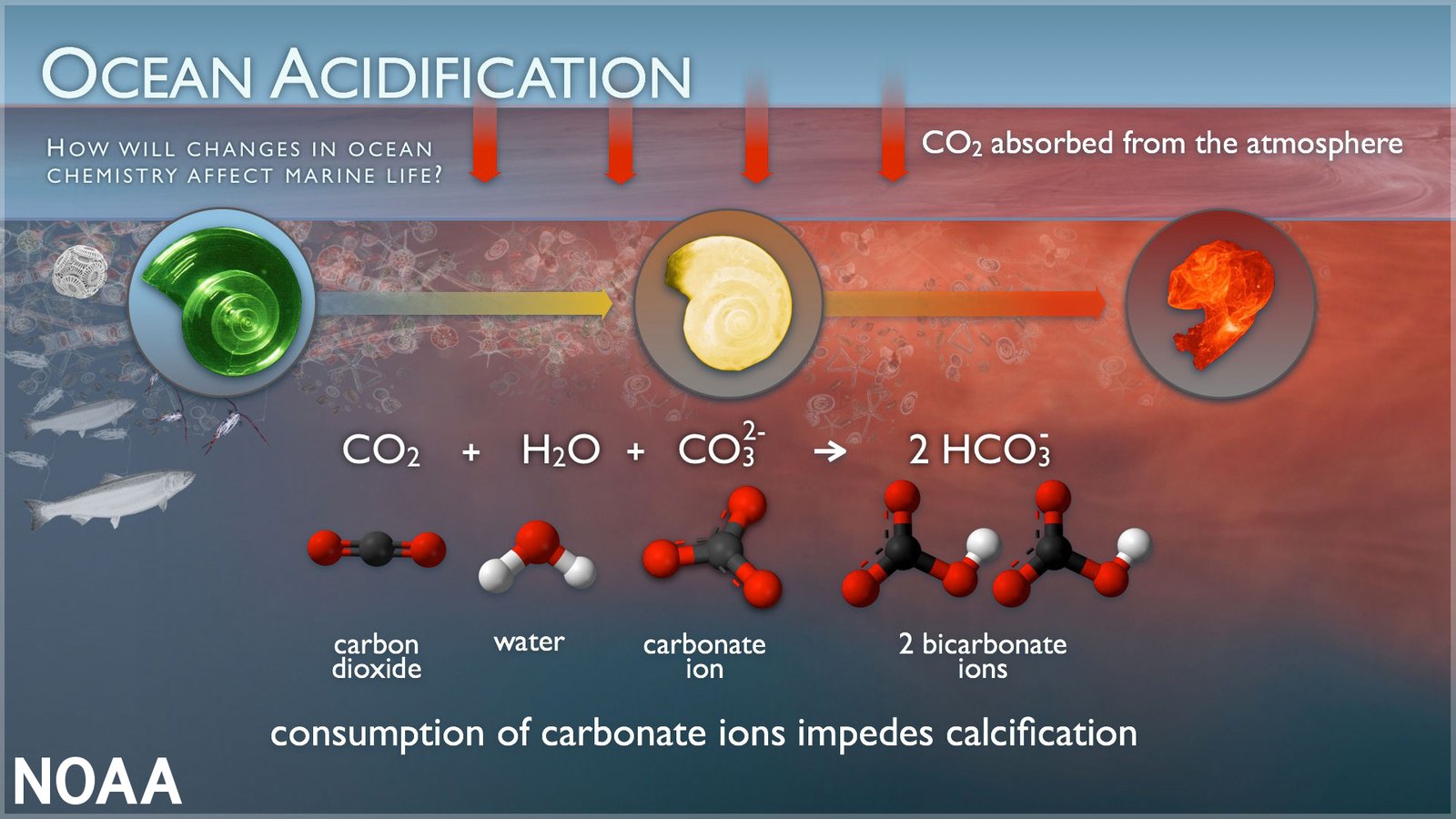
Ocean acidification begins when seawater absorbs atmospheric carbon dioxide, increasing hydrogen ions, lowering pH and reducing the carbonate ions used by many shell- and skeleton-building organisms.
Acidification describes a direction of change
Ocean acidification does not mean that the open ocean has suddenly become an acid. NOAA describes it as a reduction in ocean pH over an extended period, caused primarily by uptake of atmospheric carbon dioxide.
Because the pH scale runs in the opposite direction to acidity, a lower pH means greater acidity even while seawater remains on the alkaline side of neutral.
Carbon dioxide changes more than one number
Dissolved carbon dioxide reacts with seawater and ultimately increases the concentration of hydrogen ions. That increase lowers pH.
Hydrogen ions also interact with carbonate chemistry, leaving carbonate ions relatively less abundant. This matters because carbonate is part of the calcium-carbonate material used by many marine organisms.
Shell builders make the chemistry tangible
Oysters, clams, sea urchins, corals and pteropods are among the organisms that use calcium carbonate to build shells or skeletons. NOAA notes that reduced carbonate availability can make building and maintaining these structures more difficult.
Responses vary among species, life stages and environments, so ocean acidification should not be reduced to a claim that every shell will dissolve in the same way.
Measurements matter more than colour or appearance
Ocean acidification cannot be diagnosed by looking at seawater. Scientists monitor variables such as pH, carbon dioxide and the saturation state of calcium-carbonate minerals.
For a specific coast, shellfish operation or marine ecosystem, use current observations and research from the responsible scientific or management authority rather than applying a global explanation as a local measurement.
Before you decide
Keep these five things with you.
- 01Remember that acidification means decreasing pH, not necessarily pH below 7
- 02Connect atmospheric carbon dioxide uptake with changing seawater carbonate chemistry
- 03Distinguish global ocean change from local measurements
- 04Look for authoritative pH, carbon dioxide and carbonate-mineral observations when evaluating a specific region
- 05Avoid assuming every marine organism responds identically
How this story earns trust
Sources, method and relationship—visible.
Each reference is tagged by the geography and authority of the source. Country-specific evidence is never presented as a global rule.
Method
This Essence article was researched, drafted and editorially reviewed by the Eight June AI-managed workflow using current NOAA Ocean Service, NOAA Ocean Acidification Program and NOAA Ocean Exploration explanations of ocean acidification.
Commercial relationship
Independent editorial. NOAA did not pay for inclusion. This article is an educational explanation, not a local water-quality assessment, fisheries recommendation or environmental certification.
Correction or improvement
Found a mistake, a missing perspective or a source we should review? Send it to the editorial desk ↗
- 01What is Ocean Acidification? ↗
NOAA Ocean Service. Official explanation of carbon-dioxide uptake, pH change and carbonate-ion availability.
- 02What is Ocean Acidification? ↗
NOAA Ocean Acidification Program. Official chemistry overview and explanation that the ocean remains alkaline while acidity increases.
- 03What is ocean acidification? ↗
NOAA Ocean Exploration. Official explanation of carbonate chemistry and implications for calcifying marine organisms.
If this made you pause, pass the blue forward.
Why does absorbing carbon dioxide change ocean chemistry?
Ready to share
Made for personal and editorial sharing with Eight June attribution. Facts are shortened for the card; the article carries the full context, method and sources.
Useful questions
Quick answers,
kept specific.
Does ocean acidification mean seawater has become acidic?
No. Average ocean water remains alkaline, but its pH is decreasing and its acidity is increasing relative to earlier conditions.
Why are carbonate ions important?
They are an important building block for calcium-carbonate shells and skeletons made by organisms including oysters, clams, corals and pteropods.
Can you see ocean acidification by looking at the sea?
No. It is a chemical change measured with observations such as pH, carbon dioxide and calcium-carbonate mineral saturation.