Why · Essence
Why shipworms bore into submerged wood
The holes in sea-worn timber tell a story about a surprising marine mollusc, its food and its relationship with bacteria.
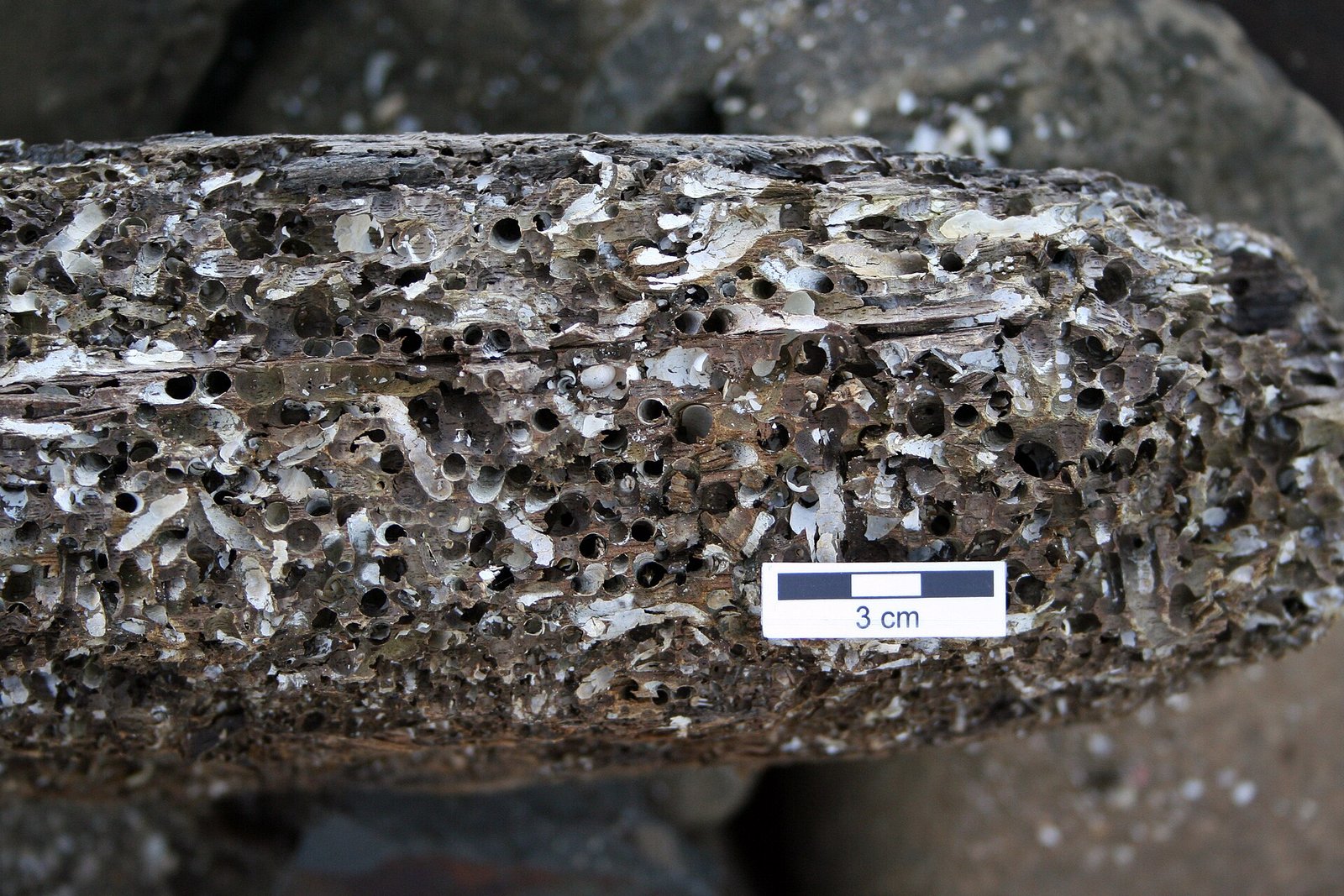
A clam with an unexpected shape
Harvard’s museum account describes the naval shipworm, Teredo navalis, as a bivalve: the same broad mollusc group as clams and mussels. Its small shell sits at the front of a long body. Instead of enclosing that body in a large protective shell, the animal occupies a burrow in wood. The name can therefore mislead twice: it is not a worm, and wooden ships are not its only home.
The shell does the scraping
The hard shell surfaces work against the timber, producing particles the animal can ingest. Northeastern’s account of its researchers’ work explains the connection between this mechanical action and the enzymes involved in digestion. Boring and digesting are different parts of the process: making a tunnel alone does not explain how the animal gains nourishment from difficult-to-break-down wood.
The biology is more interesting than a nickname
In 2022, Northeastern researchers described a route by which digestive enzymes travel from the gill region towards the digestive tract through tiny ducts. NSF’s report on separate research in 2024 describes bacteria found in an overlooked digestive structure, the typhlosole. These accounts concern particular investigations; they should not be flattened into a claim that every shipworm species has an identical digestive system.
The useful distinction is between observing the burrow and explaining the living partnership. The holes are visible evidence of activity. The distribution of microbes and the movement of enzymes require laboratory investigation. A beach photograph cannot establish those details.
Read the wood without diagnosing it
The term shipworm covers more than one species. For a curious shore visitor, the burrows offer a way into marine natural history. For someone responsible for a boat, pier or historic wooden structure, the question is different: what is the timber’s actual condition, and what assessment does it need? This article cannot identify an active infestation or determine whether wood is sound. Seek a qualified inspection for those decisions.
Before you decide
Keep these five things with you.
- 01A shipworm is a bivalve mollusc, despite its worm-like name.
- 02Wood-boring shipworms use submerged timber for food and shelter.
- 03Shell surfaces scrape wood; digestion is a separate biological process.
- 04Research findings about one digestive system should not be applied automatically to every species.
- 05A photograph of burrows cannot establish the condition of structural timber.
How this story earns trust
Sources, method and relationship—visible.
Each reference is tagged by the geography and authority of the source. Country-specific evidence is never presented as a global rule.
Method
Researched and drafted by AI from the linked Harvard museum, Northeastern University and NSF sources. A separate AI editorial read-back checked factual scope, duplicate subjects, image attribution and the five Share Studio cards on 22 October 2026. No human review is claimed. This is marine discovery information, not species identification, a timber survey or treatment advice.
Commercial relationship
Independent editorial information. Any affiliate links or paid placements will be clearly labelled where they appear.
Correction or improvement
Found a mistake, a missing perspective or a source we should review? Send it to the editorial desk ↗
- 01Shipworm · What’s in a Name? ↗
Harvard Museum of Natural History. Bivalve identity, reduced shell, wood burrowing and the limits of the common name.
- 02Shipworms and their digestive process ↗
Northeastern University College of Science. The university’s account of its 2022 enzyme-transport research.
- 03Shipworms still hold some sea-crets ↗
U.S. National Science Foundation. Archived 2024 science report on research into bacteria in the typhlosole; not current policy guidance.
If this made you pause, pass the blue forward.
Why shipworms bore into submerged wood
Ready to share
Made for personal and editorial sharing with Eight June attribution. Facts are shortened for the card; the article carries the full context, method and sources.
Useful questions
Quick answers,
kept specific.
Are shipworms actually worms?
No. The naval shipworm is a bivalve mollusc; its long body makes the common name misleading.
Is the wood only a shelter?
For wood-boring shipworms, it is also food. Scraping particles and digesting them involve different processes.
Can I judge a wooden structure from a picture of burrows?
No. An image does not establish structural condition or whether an infestation is active. Ask a qualified inspector.