How · Yours
How do octopuses change colour so quickly underwater?
An octopus can blend into a reef in moments. Learn how chromatophores, reflecting cells and changing skin texture work together—and what camouflage cannot tell us.
The pigment cells that act in an instant
The Smithsonian Ocean explains that chromatophores contain elastic sacs of pigment. When muscles around a sac pull it outward, more of its colour is visible; when the sac contracts, the coloured area becomes smaller. Neural control makes many tiny changes possible across the skin at once.
Pigment is not newly manufactured each time the animal changes appearance. The change largely comes from exposing or concealing pigments already held in specialised cells.
Why a brown pigment cell is not the whole palette
Smithsonian Ocean describes two additional optical contributors in some cephalopods. Iridophores reflect light and can produce shimmering colours, while leucophores scatter surrounding light. These effects work with chromatophores rather than replacing them.
An underwater colour is also affected by ambient light, depth and camera settings. A single photograph cannot reliably reveal the exact mechanism behind every patch.
Skin can imitate the shape of the seabed
Colour is only one layer of disguise. Some octopuses raise or flatten small projections called papillae, changing from a relatively smooth surface to a rougher, more irregular outline.
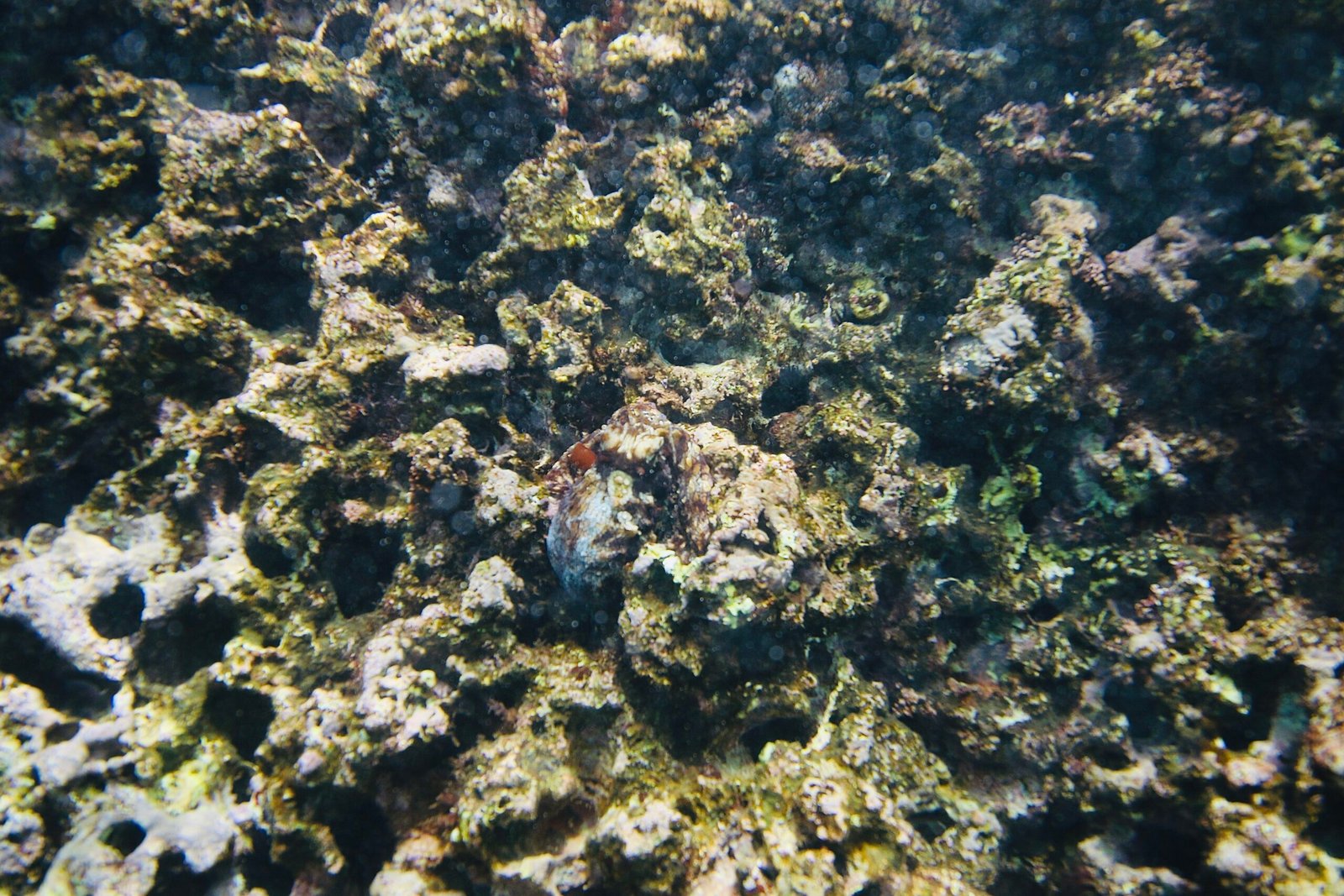
An octopus resting among stones can therefore resemble the colour and texture of its surroundings. The image accompanying this article shows a camouflaged animal against coral; it is an example, not a timed record of its colour change.
Camouflage is not the same as communication
NOAA Ocean Exploration notes that cephalopods can change colour for concealment and signalling. An animal may display a striking pattern in one context and become difficult to detect in another.
A darkening or sudden contrast change should not automatically be described as fear, anger or friendliness. Behaviour must be interpreted with species, setting and repeated observation in mind.
What a diver or photographer should do
Observe without touching, chasing, cornering or repeatedly disturbing an octopus to force a display. Give the animal space and avoid moving reef material just to reveal a hidden subject.
If a photograph shows an octopus apparently vanishing into the background, describe the observed camouflage rather than claiming the animal has matched every colour perfectly or that its intention is known.
The limits of the comparison
Octopuses are not identical in their skin patterns or habitats. Some colour-changing explanations cover octopuses, squid and cuttlefish together, but a particular demonstration from one species should not be assumed to apply to all.
The useful takeaway is a layered system: adjustable pigment, light-reflecting structures and changeable texture. That is more accurate than saying an octopus simply turns the same colour as whatever it touches.
Before you decide
Keep these five things with you.
- 01Look for chromatophores as the main pigment-display mechanism.
- 02Distinguish pigment expansion from the reflective effects of iridophores and leucophores.
- 03Notice skin texture and body outline, not only apparent colour.
- 04Avoid assigning a specific emotion to one isolated colour change.
- 05Watch marine wildlife from a distance without provoking camouflage or defensive displays.
How this story earns trust
Sources, method and relationship—visible.
Each reference is tagged by the geography and authority of the source. Country-specific evidence is never presented as a global rule.
Method
AI-assisted editorial synthesis of Smithsonian Ocean and NOAA Ocean Exploration primary educational explanations. Current GitHub catalogues, 39 legacy daily articles, dated daily packages through 5 November and remote-media declarations were checked for duplicate search intent and imagery. The public native WordPress inventory could not be retrieved. The Wikimedia Commons photograph's creator, licence, dimensions and direct JPEG rendering were checked.
Commercial relationship
Independent informational editorial; no sponsorship, affiliate payment, endorsement or commercial relationship with Smithsonian, NOAA or the photographer is represented.
Correction or improvement
Found a mistake, a missing perspective or a source we should review? Send it to the editorial desk ↗
- 01How Octopuses and Squids Change Color ↗
Smithsonian Ocean. Chromatophores, neural and muscular control, reflecting cells, skin papillae and camouflage.
- 02Squid — NOAA Ocean Exploration ↗
NOAA Ocean Exploration. Cephalopod chromatophores and colour change for camouflage and communication.
If this made you pause, pass the blue forward.
How do octopuses change colour so quickly underwater?
Ready to share
Made for personal and editorial sharing with Eight June attribution. Facts are shortened for the card; the article carries the full context, method and sources.
Useful questions
Quick answers,
kept specific.
Do octopuses make new pigment every time they change colour?
No. Rapid changes mainly alter how much pigment in existing chromatophore sacs is exposed, assisted by reflective structures.
Can an octopus change its skin texture?
Yes. Some octopuses adjust small skin projections called papillae, making their outline smoother or more irregular.
Does every colour change mean an octopus is frightened?
No. Cephalopods use changing appearances in several contexts; one photograph does not establish the animal's motivation.
Is an octopus the same as a chameleon?
No. Both can change appearance, but an octopus is a marine mollusc with a distinct skin-cell and nervous-system arrangement.