What · Pulse
What is a siphonophore—and why does it look like one animal?
A siphonophore is a colony of connected, specialised marine zooids. Its jelly-like shape can conceal an entire cooperative animal system.
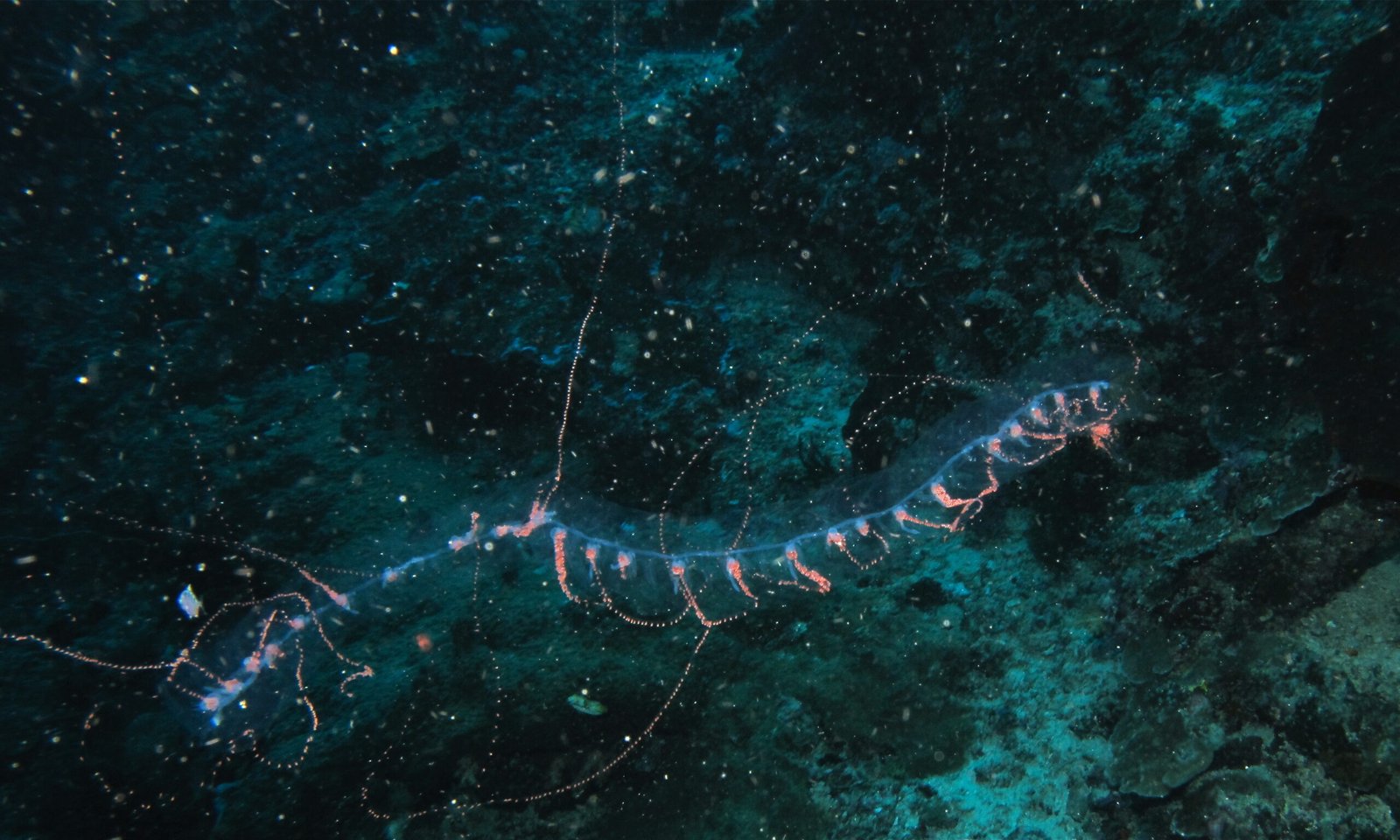
One shape can contain many individuals
At first glance a siphonophore may resemble a translucent jellyfish or a floating strand. The visible outline is misleading: the colony consists of many connected units called zooids.
NOAA identifies siphonophores as hydrozoans in the cnidarian family tree, related to jellyfish, corals and sea anemones. They are all marine, not freshwater animals.
Each zooid has a particular job
The colony is organised by division of labour. Depending on the species, specialised zooids are involved in swimming, catching food, reproduction or defence.
Smithsonian Ocean notes that the zooids in a colony are genetically identical. Their interdependence makes the whole colony function as one integrated animal, even though its parts are individual zooids.
Why the jellyfish comparison can confuse
A siphonophore and a true jellyfish share a wider cnidarian ancestry, but they do not have the same organisation. A siphonophore is colonial; a typical single jellyfish is not a string of zooids with separate roles.
The Portuguese man o’ war is a well-known surface-dwelling siphonophore. Other siphonophores occur deeper in the ocean, where exploration vehicles sometimes reveal their long, delicate forms.
A floating colony can still be a predator
Some zooids bear tentacles and stinging structures that help catch prey. The colony coordinates its specialised parts to capture food and sustain itself in the water column.
Not all siphonophores have the same shape, size or habitat. The important recognition clue is the colonial organisation, not a promise that every translucent marine animal is a siphonophore.
How to read a siphonophore photograph
Look for repeating units, bells or tentacles along an extended structure, while remembering that a photograph alone may not reveal every zooid or identify the species.
Treat spectacular length claims cautiously: colony dimensions differ by species and observations. For a reliable identification, use the scientific description accompanying the image rather than visual resemblance alone.
Before you decide
Keep these five things with you.
- 01Start with the word colony: a siphonophore is made of connected zooids.
- 02Remember that zooids are specialised for different jobs.
- 03Do not mistake every siphonophore for a single jellyfish.
- 04Recognise the Portuguese man o’ war as a siphonophore example.
- 05Check a scientific caption before identifying a transparent marine animal from a photo.
How this story earns trust
Sources, method and relationship—visible.
Each reference is tagged by the geography and authority of the source. Country-specific evidence is never presented as a global rule.
Method
The Eight June AI-managed editorial workflow compared NOAA Ocean Exploration and Smithsonian Ocean descriptions of siphonophore anatomy, colony structure and cnidarian relationships. The current repository article catalogue and available dated packages were screened for overlapping siphonophore intent; live WordPress inventory endpoints could not be retrieved by the independent web layer.
Commercial relationship
Independent informational editorial. NOAA, Smithsonian, the photographer and Wikimedia Commons have not sponsored this article, and no affiliate relationship is represented.
Correction or improvement
Found a mistake, a missing perspective or a source we should review? Send it to the editorial desk ↗
- 01Wild and Bizarre Marine Life — Siphonophores: In This Together ↗
NOAA Ocean Exploration. Primary federal explanation of colonial hydrozoans, zooid roles and marine distribution.
- 02Siphonophores ↗
Smithsonian Ocean. Museum description of genetically identical, specialised zooids and Portuguese man o’ war.
- 03Jellyfish and Comb Jellies ↗
Smithsonian Ocean. Scientific comparison of jellyfish, hydrozoans and colonial siphonophores.
If this made you pause, pass the blue forward.
What is a siphonophore—and why does it look like one animal?
Ready to share
Made for personal and editorial sharing with Eight June attribution. Facts are shortened for the card; the article carries the full context, method and sources.
Useful questions
Quick answers,
kept specific.
Is a siphonophore a jellyfish?
It is related to jellyfish within Cnidaria, but it is a colonial hydrozoan composed of specialised connected zooids rather than one conventional jellyfish body.
Can one zooid live by itself?
Most cannot: Smithsonian Ocean describes their extreme specialisation and dependence on the connected colony.
Is a Portuguese man o’ war a siphonophore?
Yes. NOAA and Smithsonian identify it as a well-known siphonophore living at the sea surface.
Are all siphonophores deep-sea animals?
No. The Portuguese man o’ war occurs at the surface; many other siphonophore species live at greater depths.