Who · Voices
Who actually sets the rules for tuna fisheries across oceans?
Tuna cross national boundaries, so no single global regulator sets every rule. Five tuna regional fisheries management organisations coordinate major international fisheries, while coastal, flag and port states still apply their own legal responsibilities.
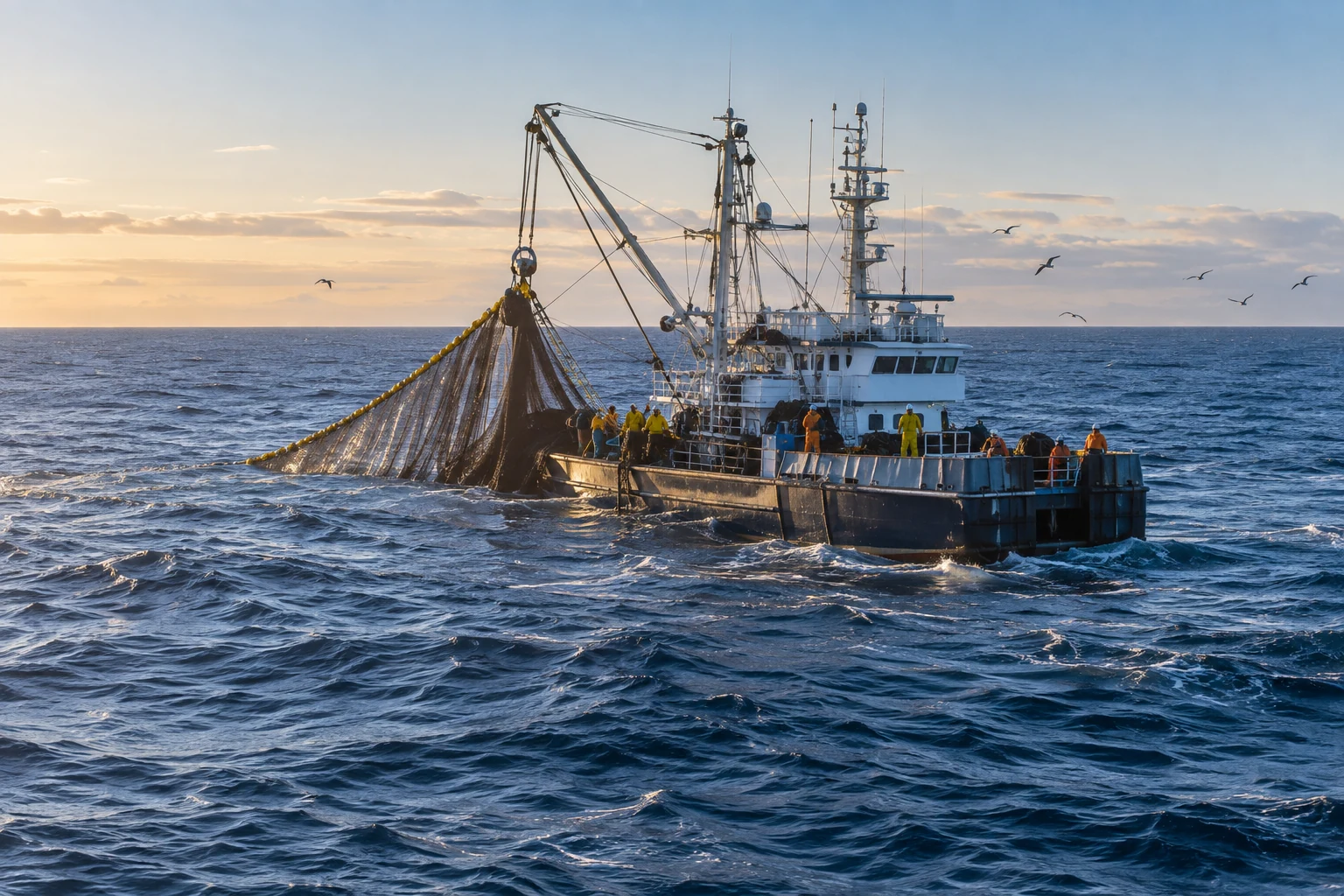
Tuna move farther than one jurisdiction
Many commercial tuna stocks move through waters governed by different states and, in some cases, the high seas. That makes management a shared problem: a rule applied in one national zone cannot by itself govern the same stock throughout its range.
FAO’s Common Oceans tuna programme therefore works with five tuna regional fisheries management organisations, or tRFMOs. They provide the main international forums through which participating governments cooperate on major tuna and tuna-like fisheries in different ocean areas.
Five regional bodies divide the ocean rather than one body ruling the world
The five organisations are the Commission for the Conservation of Southern Bluefin Tuna (CCSBT), Inter-American Tropical Tuna Commission (IATTC), International Commission for the Conservation of Atlantic Tunas (ICCAT), Indian Ocean Tuna Commission (IOTC), and Western and Central Pacific Fisheries Commission (WCPFC). Their mandates are not interchangeable: each has its own convention area, membership, species or stock responsibilities and decision process.
IOTC describes itself as the intergovernmental organisation responsible for managing tuna and tuna-like species in the Indian Ocean. WCPFC describes the Commission’s annual meeting as its ultimate decision-making body and says the Commission adopts Conservation and Management Measures. ICCAT likewise brings contracting parties together to agree conservation and management measures for Atlantic tunas and tuna-like species.
- Indian Ocean: check IOTC measures and the relevant coastal or flag-state rules
- Western and central Pacific: check WCPFC measures and applicable national rules
- Atlantic: check ICCAT measures and the law implementing them
- Do not transfer a rule from one ocean or stock to another without checking scope
A regional measure still has to meet vessels, ports and national law
Regional commissions agree measures through their members, but fishing happens through vessels licensed, flagged, landing or transshipping under particular legal systems. That is why a vessel can face several layers of obligation at once: the RFMO measure, a coastal state’s fishing conditions, its flag state’s controls and the requirements of a port where catch is landed or transshipped.
For a buyer or reader, this means a broad statement such as ‘RFMO managed’ is incomplete. The useful evidence identifies the stock or species, fishing area, relevant commission, vessel or fleet context where available, and the current rule or implementation source.
Use the rulebook as a verification path, not as a quality badge
An RFMO’s existence does not automatically prove that every tuna product is sustainable, legal or fully traceable. A management measure can establish catch limits, effort controls, monitoring duties or other requirements, but product-level confidence still depends on whether the specific fishery and actors comply with the applicable rules and whether the claim can be traced to reliable evidence.
A practical check starts with geography: identify the ocean and fishing area, then the species or stock, then the relevant tRFMO and current measure. After that, check the national authority or other first-party source that applies the measure to the vessel, landing or product in question.
Before you decide
Keep these five things with you.
- 01Identify the tuna species or stock rather than relying only on a market name
- 02Confirm the ocean and fishing area
- 03Find the relevant tuna regional fisheries management organisation
- 04Read the current measure for that stock or fishery
- 05Check the coastal, flag-state or port-state rule that applies to the actual fishing or landing activity
How this story earns trust
Sources, method and relationship—visible.
Each reference is tagged by the geography and authority of the source. Country-specific evidence is never presented as a global rule.
Method
This Voices article was researched, drafted, organised and editorially reviewed by the Eight June AI-managed workflow against current first-party material from FAO, IOTC, WCPFC and ICCAT. It explains the institutional map and does not assess the compliance or sustainability of any individual vessel, fleet, fishery or tuna product.
Commercial relationship
Independent editorial. FAO, IOTC, WCPFC, ICCAT and fishing operators did not pay for inclusion. Mention of a management body is not an Eight June endorsement, certification or product recommendation.
Correction or improvement
Found a mistake, a missing perspective or a source we should review? Send it to the editorial desk ↗
- 01Tuna fisheries ↗
FAO · Common Oceans Program. Current overview of the five tuna regional fisheries management organisations and their shared international role.
- 02Indian Ocean Tuna Commission ↗
IOTC. Current first-party description of IOTC’s role in managing tuna and tuna-like species in the Indian Ocean.
- 03Who we are ↗
Western and Central Pacific Fisheries Commission. Commission mandate, decision-making structure and Conservation and Management Measures.
- 04International Commission for the Conservation of Atlantic Tunas ↗
ICCAT. Current first-party description of ICCAT’s role, research coordination and management process.
If this made you pause, pass the blue forward.
Who actually sets the rules for tuna fisheries across oceans?
Ready to share
Made for personal and editorial sharing with Eight June attribution. Facts are shortened for the card; the article carries the full context, method and sources.
Useful questions
Quick answers,
kept specific.
Is there one global authority that regulates all tuna fishing?
No. Five tuna regional fisheries management organisations cover the major international tuna fisheries, alongside national and other state responsibilities.
Does an RFMO rule replace national fishing law?
No. RFMO measures are implemented and enforced through participating states and interact with coastal, flag-state and port-state requirements.
Does ‘RFMO managed’ prove a tuna product is sustainable?
No. It identifies a management framework. Product-level claims still need evidence about the specific stock, fishery, compliance and traceability.