Why · Pulse
Why can cold, nutrient-rich water suddenly rise near a coast?
Coastal upwelling happens when winds move surface water offshore and deeper, colder, nutrient-rich water rises to replace it.
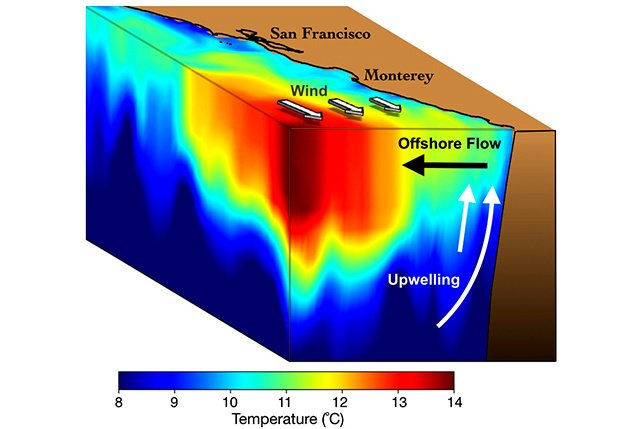
Wind can make surface water move away from shore
When winds blow along a coast, their interaction with Earth’s rotation can move surface water offshore rather than simply piling it against the beach.
The displaced surface layer has to be replaced. Water from below then rises toward the surface: that upward movement is coastal upwelling.
The water arriving from depth feels different
NOAA describes upwelled water as typically colder and nutrient-rich compared with the surface water it replaces.
That is why a coast can have chilly water even during a warm season, and why sea-surface temperature can be a useful clue to an active upwelling pattern.
Nutrients connect circulation to marine life
Nutrients carried upward can fertilize sunlit surface waters and encourage phytoplankton growth. Phytoplankton support zooplankton, forage fish and larger predators.
NOAA notes that major coastal upwelling ecosystems are highly productive and support important fisheries, although the strength and timing of upwelling vary by region and season.
Upwelling is a process, not a beach forecast
Knowing that a region experiences upwelling does not tell you the exact water temperature, current or hazard at a particular beach on a particular day.
For a real outing, use current observations and forecasts from the responsible local marine or weather authority rather than treating this explainer as operational guidance.
Before you decide
Keep these five things with you.
- 01Expect upwelling water to be colder than the displaced surface layer
- 02Connect nutrient-rich water with increased biological productivity rather than assuming cold water is biologically poor
- 03Check whether upwelling is seasonal in the coast you are studying
- 04Separate the regional ocean process from a same-day beach or boating forecast
- 05Use the controlling local authority for current marine conditions
How this story earns trust
Sources, method and relationship—visible.
Each reference is tagged by the geography and authority of the source. Country-specific evidence is never presented as a global rule.
Method
This Pulse article was researched, drafted and editorially reviewed by the Eight June AI-managed workflow using NOAA Ocean Service, NOAA Ocean Exploration and NOAA Fisheries material on coastal upwelling.
Commercial relationship
Independent editorial. NOAA did not pay for inclusion. This explainer is not a marine forecast, navigation service or recommendation to enter the water.
Correction or improvement
Found a mistake, a missing perspective or a source we should review? Send it to the editorial desk ↗
- 01What is upwelling? ↗
NOAA Ocean Service. Official definition and explanation of cold, nutrient-rich water rising toward the surface.
- 02What is upwelling? ↗
NOAA Ocean Exploration. Official explanation of wind-driven coastal upwelling and its relationship with marine productivity.
- 03Oceanography of the Northern California Current Study Area ↗
NOAA Fisheries. Current NOAA Fisheries context for coastal upwelling and marine production in the California Current.
If this made you pause, pass the blue forward.
Why can cold, nutrient-rich water suddenly rise near a coast?
Ready to share
Made for personal and editorial sharing with Eight June attribution. Facts are shortened for the card; the article carries the full context, method and sources.
Useful questions
Quick answers,
kept specific.
Is upwelled water usually cold?
Yes. NOAA describes water rising during upwelling as typically colder than the surface water it replaces.
Why can upwelling support fisheries?
The rising water carries nutrients into sunlit surface waters, supporting phytoplankton and the food web above them.
Does upwelling happen on every coast all the time?
No. Its strength, timing and location depend on winds, coastline and ocean circulation, and many regions have seasonal patterns.