Why · Essence
Why can lost fishing gear keep fishing after nobody owns the catch?
Abandoned, lost or otherwise discarded fishing gear can continue trapping and entangling marine life after it has left a working fishery. FAO calls this continuing capture ‘ghost fishing’; marking, reporting and retrieval are part of the response.
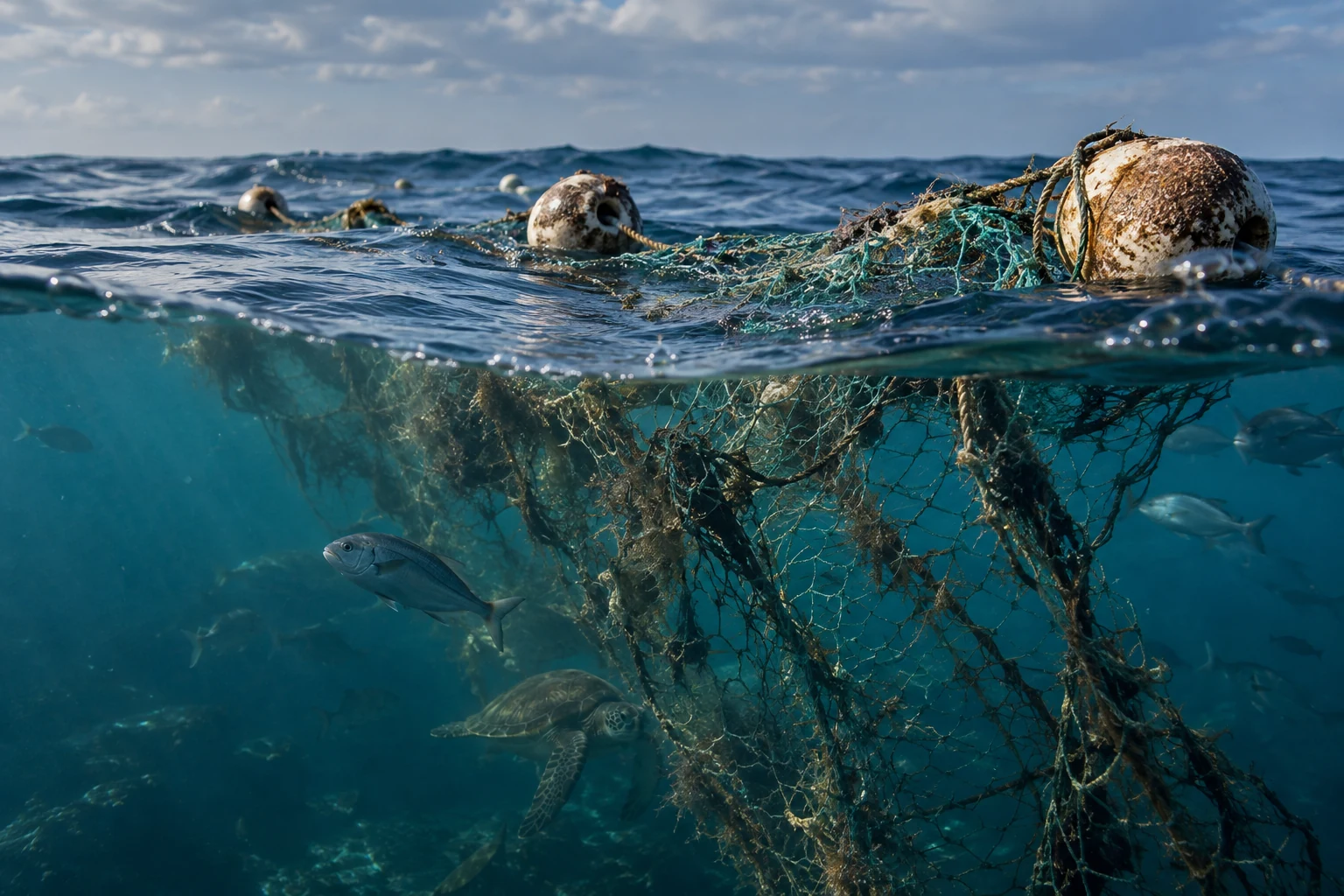
The gear can keep doing what it was built to do
FAO uses the term abandoned, lost or otherwise discarded fishing gear—ALDFG—for fishing gear that has left active control. Because some nets, pots, traps and lines continue to retain or entangle animals after they are lost, the gear can keep catching without anyone intentionally fishing it.
That continuing capture is commonly called ghost fishing. It can affect target species as well as non-target wildlife, and the effect can persist until the gear is recovered, breaks down, becomes buried or otherwise stops functioning as fishing gear.
The damage is not limited to what gets caught
FAO identifies impacts on fish stocks, endangered species and benthic environments, and also notes that lost gear can create navigational hazards. IMO treats fishing gear within the broader marine-litter problem because ropes, nets and related components can persist and move beyond the place where they were lost.
The exact risk depends on the gear type, material, location, depth, currents and how long it remains functional. That is why a single global estimate cannot describe every coast or fishery, and why local reporting and retrieval programmes matter.
- Entanglement or continued capture of marine animals
- Damage or abrasion to seabed and coastal habitats
- Navigation and vessel-safety hazards
- Long-lived plastic and synthetic material entering the marine environment
Marking and reporting help turn anonymous debris into accountable gear
FAO says its Voluntary Guidelines on the Marking of Fishing Gear were endorsed by the Committee on Fisheries in 2018. Marking can support identification, reporting, recovery and enforcement, although the exact system must fit the fishery and national or regional rules.
IMO’s current marine-litter work also covers reporting lost fishing gear and improving gear marking. These systems matter because recovery is easier to organise when authorities know what was lost, where it was lost and who is responsible for reporting or retrieving it.
Retrieval is useful, but prevention comes first
Retrieving gear can remove an active hazard, but recovery at sea may itself involve safety, cost, environmental and legal constraints. The better sequence is to reduce avoidable loss, mark gear where required or appropriate, report losses promptly, and recover gear when it can be done safely and under the relevant rules.
For readers choosing seafood or following a fishery, the useful questions are practical: what gear is used, what loss-prevention and reporting rules apply, whether retrieval programmes exist, and which authority publishes current guidance for that fleet or area.
Before you decide
Keep these five things with you.
- 01Ask what gear type the fishery uses and how loss risk is managed
- 02Check whether gear marking is required or used in that fishery
- 03Look for a clear lost-gear reporting process
- 04Use official local guidance before attempting any retrieval
- 05Treat ghost-gear claims as fishery-specific rather than universal
How this story earns trust
Sources, method and relationship—visible.
Each reference is tagged by the geography and authority of the source. Country-specific evidence is never presented as a global rule.
Method
This Essence article was researched, drafted, organised and editorially reviewed by the Eight June AI-managed workflow using current first-party guidance from FAO and IMO. It avoids historic global tonnage estimates and focuses on mechanisms and response measures that the controlling sources directly support.
Commercial relationship
Independent editorial. FAO, IMO, fishing operators and gear manufacturers did not pay for inclusion. The article does not certify or rank any fishery, gear type or seafood product.
Correction or improvement
Found a mistake, a missing perspective or a source we should review? Send it to the editorial desk ↗
- 01Abandoned, lost or otherwise discarded fishing gear (ALDFG) ↗
FAO · Responsible Fishing Practices. Definition, ghost-fishing impacts, navigation risks and international response context.
- 02Marine litter ↗
International Maritime Organization. Current IMO work on marine plastic litter from ships, including fishing-gear marking and lost-gear reporting.
- 03Solutions to abandoned, lost or otherwise discarded fishing gear ↗
International Maritime Organization. Reporting, retrieval and prevention approaches discussed through the IMO/FAO fishing-gear work.
If this made you pause, pass the blue forward.
Why can lost fishing gear keep fishing after nobody owns the catch?
Ready to share
Made for personal and editorial sharing with Eight June attribution. Facts are shortened for the card; the article carries the full context, method and sources.
Useful questions
Quick answers,
kept specific.
What is ghost fishing?
It is continued capture by fishing gear after that gear has been abandoned, lost or otherwise left outside active control.
Is lost fishing gear only a plastic-pollution problem?
No. It can also continue catching animals, affect habitats and create navigation hazards, depending on the gear and location.
Should anyone who finds lost gear simply remove it?
Not automatically. Retrieval can involve safety, ownership, protected-area and waste-handling rules. Follow the relevant local authority or programme guidance.