Why · Essence
Why do some pearls glow more deeply than others?
A pearl does not need to be large, white or perfectly round to look alive. The quality you notice first is usually light—how cleanly it returns from the surface and how softly it appears to rise from within.
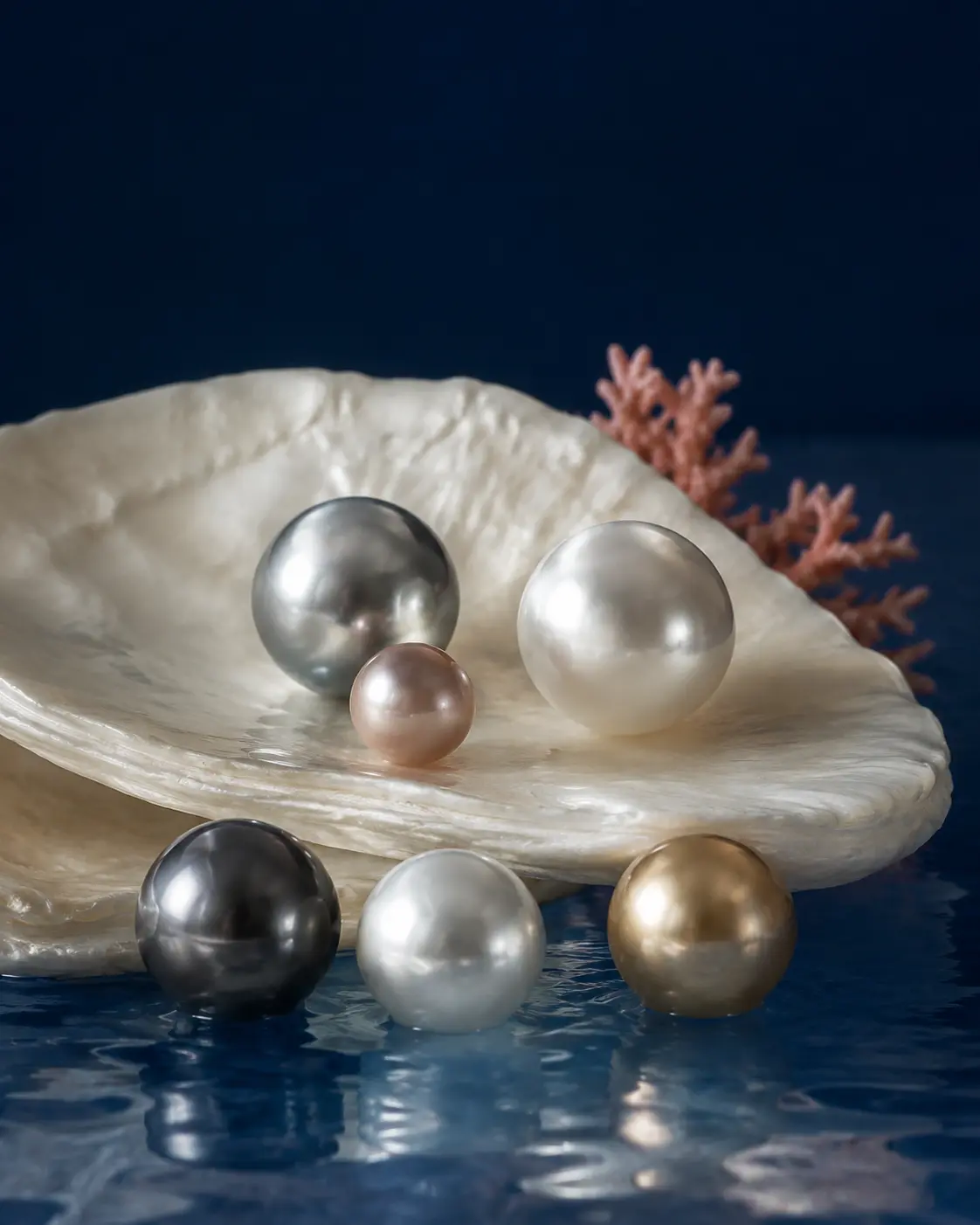
The light is doing two things
GIA describes lustre as one of the seven pearl value factors and, for many pearls, the most important. A high-lustre pearl returns reflections that look bright and sharp. A lower-lustre pearl looks hazier or chalkier, even when it is bigger.
Nacre—the material laid down by the mollusc—also influences how light behaves and how durable a cultured pearl may be. GIA’s 2025 update gives greater attention to nacre continuity, rather than treating it as a simple pass-or-fail detail.
A five-minute comparison in a shop
Ask to see two or three pearls of the same type and broadly similar size. Stand near a window or under neutral white light; warm spotlights can flatter almost anything. Roll each pearl slowly and watch the reflected edge of a window, your phone or your own face.
A lively pearl holds a clearer reflection as it moves. Then look for dull patches, a visible bead nucleus, distracting blemishes or weak matching across a strand. Surface marks can be natural and beautiful; the question is whether they disturb the whole piece.
- Compare like with like: akoya with akoya, freshwater with freshwater.
- Judge lustre before size.
- View the piece on skin as well as on a tray.
What the invoice should make clear
Natural, cultured and imitation are not interchangeable words. A responsible seller should identify the product accurately and disclose treatments that materially affect appearance. Ask for pearl type, metal fineness, treatments, return terms and any laboratory report in writing.
A certificate is useful only when you can identify who issued it and what was tested. It does not replace looking carefully. The right pearl is the one whose beauty, description and price agree with one another.
Before you decide
Keep these five things with you.
- 01See it in neutral light
- 02Compare similar pearl types
- 03Ask whether it is natural, cultured or imitation
- 04Get treatments and metal fineness in writing
- 05Check returns before paying
How this story earns trust
Sources, method and relationship—visible.
Each reference is tagged by the geography and authority of the source—not by the reader’s location. A country tag means the evidence is country-specific; it is never presented as a global rule.
Method
This explainer compares current GIA value-factor guidance with consumer-description principles in the FTC Jewelry Guides. It does not grade or value an individual pearl.
Commercial relationship
Independent editorial. No seller, pearl farm or laboratory paid for inclusion. No product was tested for this article.
Correction or improvement
Found a mistake, a missing perspective or a source we should review? Send it to the editorial desk ↗
- 01Pearl Quality Factors ↗
Gemological Institute of America. The seven observable value factors, including lustre, surface and nacre.
- 02GIA 7 Pearl Value Factors: 2025 nacre update ↗
Gemological Institute of America. Updated treatment of nacre continuity and durability.
- 03Jewelry Guides ↗
U.S. Federal Trade Commission. Consumer-protection guidance on accurate descriptions and material disclosures.
If this made you pause, pass the blue forward.
Why do some pearls glow more deeply than others?
Ready to share
Made for personal and editorial sharing with Eight June attribution. Facts are shortened for the card; the article carries the full context, method and sources.
Questions readers ask next
Three sourced answers
to keep close.
What is the shortest answer?
The deepest glow usually comes from strong lustre working with sound nacre and a reasonably clean surface. Size, shape and colour affect preference and value, but none can replace lively light return.
Which evidence is carrying the answer?
The evidence trail names Pearl Quality Factors, GIA 7 Pearl Value Factors: 2025 nacre update, Jewelry Guides. Open those records for their exact scope, geography, definitions and update dates.
What should I carry into the decision?
The page’s checklist highlights these points: See it in neutral light; Compare similar pearl types; Ask whether it is natural, cultured or imitation; Get treatments and metal fineness in writing. Use the linked sources to confirm any detail that changes by place, provider or date. The editorial information on this page was last reviewed on 1 September 2026. Time-sensitive conditions, prices, rules and availability should still be confirmed at the linked source on the day they matter.