Why · Essence
Why do ordinary materials fail faster beside the sea?
A coastal home ages in public. Hinges bloom with rust, fabrics fade, finishes lift and timber moves—not because the sea is careless, but because salt, water, heat and light keep working after the view has gone quiet.
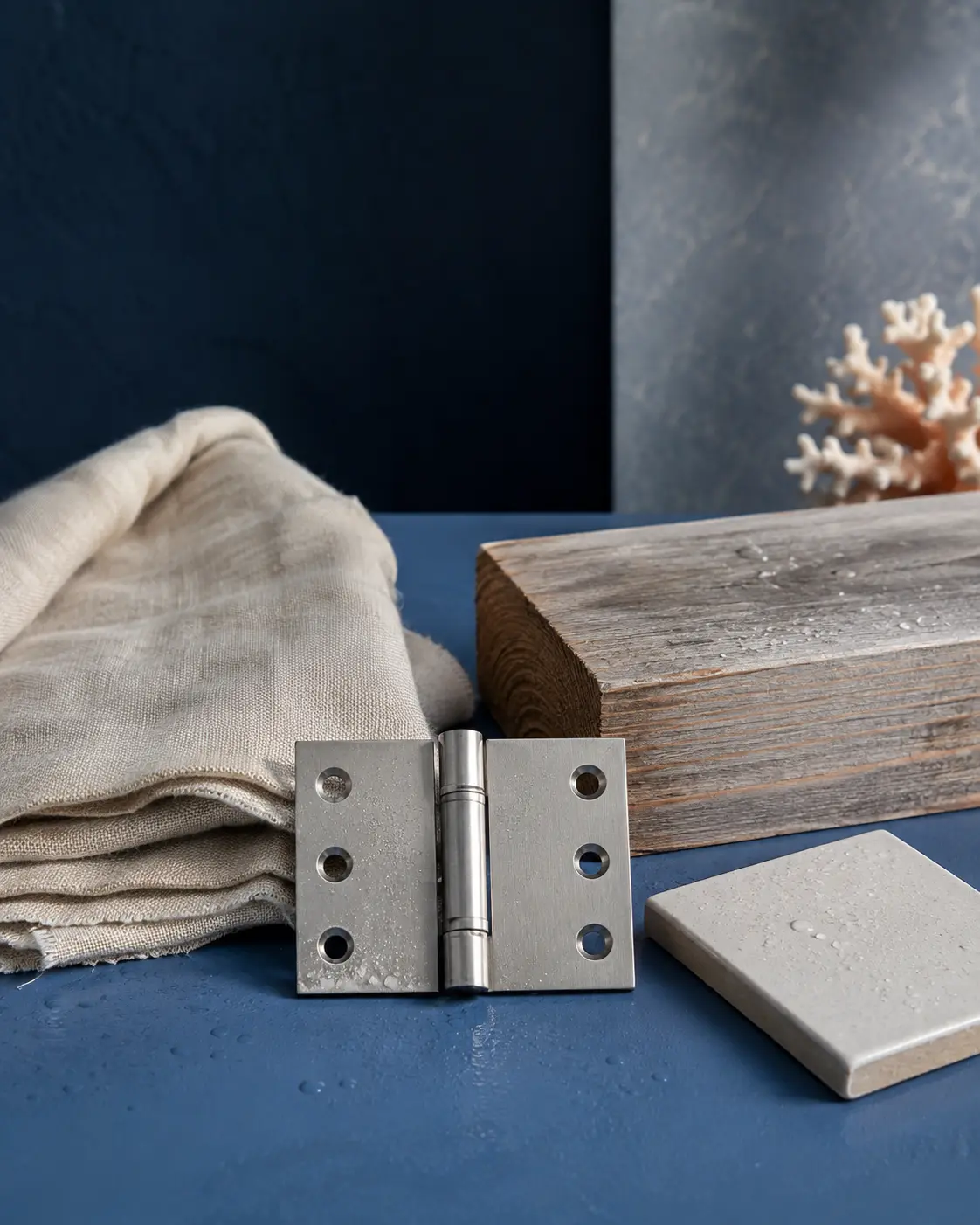
Salt rarely works alone
Sea spray leaves chloride-rich deposits on exposed surfaces. On metals, moisture and chlorides accelerate corrosion. In reinforced concrete, chlorides can eventually disturb the protection around steel; expanding corrosion can lead to cracking and spalling.
Humidity keeps materials damp for longer. Timber and natural fibres exchange moisture with the air, hidden cavities dry slowly, and strong sunlight fades pigments and makes some plastics, sealants and coatings brittle.
The details fail before the big idea
A beautiful outdoor chair may have a suitable frame but ordinary screws. A marine-grade fitting may sit inside a detail that traps water. A stone may tolerate salt while the metal anchor behind it does not. Coastal design succeeds at the joints: drainage, ventilation, compatible metals, replaceable fixings and access for cleaning.
Stainless steel is not one universal material and galvanising is not permanent armour. Exposure, alloy, finish, fabrication and maintenance all matter. Use a qualified local professional for structural, electrical or safety-critical work.
- Prefer details that shed water.
- Avoid direct contact between incompatible metals.
- Make high-wear parts replaceable.
- Keep care instructions before installation.
A practical coastal rhythm
Rinse exposed hardware and outdoor furniture with fresh water when salt build-up is visible, following the maker’s instructions. Inspect hinges, railings, fasteners, sealants and electrical enclosures before the wettest or stormiest season.
The first stain is information. Record it, find the moisture or salt path, and correct the detail before hiding it under another coat.
Before you decide
Keep these five things with you.
- 01Ask what the fixings are made from
- 02Check drainage and drying paths
- 03Keep unlike metals separated
- 04Plan fresh-water cleaning
- 05Inspect hidden and safety-critical parts
How this story earns trust
Sources, method and relationship—visible.
Each reference is tagged by the geography and authority of the source—not by the reader’s location. A country tag means the evidence is country-specific; it is never presented as a global rule.
Method
This article translates building-science and infrastructure guidance into household questions. It is not a specification for a particular building, product or exposure zone.
Commercial relationship
Independent editorial. No material or building-product manufacturer paid for inclusion. No laboratory testing was conducted.
Correction or improvement
Found a mistake, a missing perspective or a source we should review? Send it to the editorial desk ↗
- 01Corrosion Resistant Alloys for Reinforced Concrete ↗
U.S. Federal Highway Administration. The sequence of chloride-induced corrosion in reinforced concrete.
- 02Recommendations for hot-humid coastal construction ↗
U.S. Department of Energy / Building Science Corporation. Practical guidance on coastal corrosion, fasteners and moisture.
- 03Understanding Attic Ventilation ↗
Building Science Corporation. Salt-spray and corrosion risks in coastal assemblies.
If this made you pause, pass the blue forward.
Why do ordinary materials fail faster beside the sea?
Ready to share
Made for personal and editorial sharing with Eight June attribution. Facts are shortened for the card; the article carries the full context, method and sources.
Questions readers ask next
Three sourced answers
to keep close.
What is the shortest answer?
Salt attracts and holds moisture, humidity slows drying, ultraviolet light breaks down many finishes, and wind drives salt into joints. Coastal durability is a system of material choice, detailing, cleaning and inspection—not a miracle coating.
Which evidence is carrying the answer?
The evidence trail names Corrosion Resistant Alloys for Reinforced Concrete, Recommendations for hot-humid coastal construction, Understanding Attic Ventilation. Open those records for their exact scope, geography, definitions and update dates.
What should I carry into the decision?
The page’s checklist highlights these points: Ask what the fixings are made from; Check drainage and drying paths; Keep unlike metals separated; Plan fresh-water cleaning. Use the linked sources to confirm any detail that changes by place, provider or date. The editorial information on this page was last reviewed on 1 September 2026. Time-sensitive conditions, prices, rules and availability should still be confirmed at the linked source on the day they matter.