Who · Voices
The hands behind a pearl’s final lustre
A pearl arrives without a designer’s sketch inside it. Its final character is built through decisions—on the water, at the sorting table, beside the drill and at the jeweller’s bench.
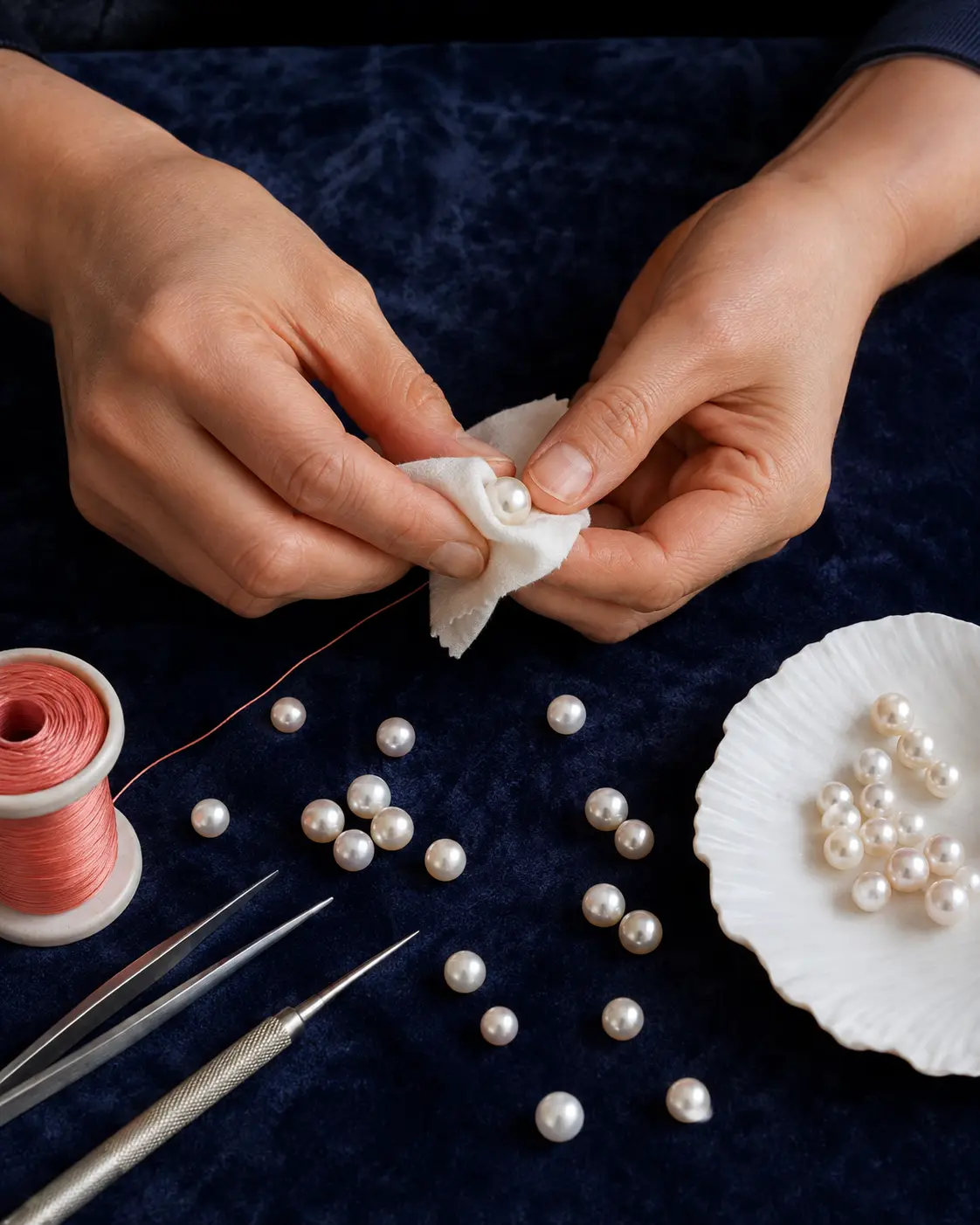
The work begins with a living animal
Cultured pearl production depends on a mollusc responding to human intervention inside a changing aquatic environment. Farm teams monitor water, clean shells, manage threats and decide when an oyster is ready.
The 2025 CIBJO Pearl Special Report describes investment in environmental monitoring, responsible practice and clearer terminology. Those ambitions are not proof that every pearl is sustainable; they show which questions the trade knows it must answer.
Sorting is a language of tiny differences
After harvest, pearls may be cleaned, processed where permitted and separated repeatedly by size, shape, colour, lustre and surface. Matching a strand asks the sorter to balance sameness with flow.
Drilling position affects how a pearl faces and how much material remains around the hole. Designers and setters then choose whether to celebrate irregularity or impose symmetry.
Keep the people in the purchase
Ask what the seller knows beyond pearl type and millimetres. Origin, processing, matching and repairability are reasonable questions. ‘We do not know’ is better than a decorative story invented later.
If a brand speaks about community or environmental benefit, look for a named programme, standard, farm, audit or report. Provenance is information that can be checked.
- Who cultivated or sourced the pearls?
- Where were they sorted, drilled and assembled?
- Were treatments used?
- Can the piece be repaired locally?
- What supports an impact claim?
Before you decide
Keep these five things with you.
- 01Ask who did more than sell it
- 02Request treatment disclosure
- 03Check matching in daylight
- 04Look for repairable construction
- 05Verify impact claims
How this story earns trust
Sources, method and relationship—visible.
Each reference is tagged by the geography and authority of the source—not by the reader’s location. A country tag means the evidence is country-specific; it is never presented as a global rule.
Method
This is a process explainer based on gemmological and industry-standard sources. It is not based on an Eight June farm visit or worker interview.
Commercial relationship
Independent editorial. No pearl business or trade body paid for inclusion. CIBJO is cited as an industry authority, not treated as an independent auditor of every member.
Correction or improvement
Found a mistake, a missing perspective or a source we should review? Send it to the editorial desk ↗
- 01How GIA analyzes pearls from start to finish ↗
Gemological Institute of America. Current laboratory observation and reporting.
- 02Pearl Special Report 2025 ↗
World Jewellery Confederation (CIBJO). Industry developments in terminology, traceability, science and responsible pearling.
- 03Pearl Blue Book ↗
World Jewellery Confederation (CIBJO). International pearl terminology and trade-practice guidance.
If this made you pause, pass the blue forward.
The hands behind a pearl’s final lustre
Ready to share
Made for personal and editorial sharing with Eight June attribution. Facts are shortened for the card; the article carries the full context, method and sources.
Questions readers ask next
Three sourced answers
to keep close.
What is the shortest answer?
Farmers, technicians, harvesters, cleaners, sorters, graders, drillers, matchers, designers, setters and repair specialists all shape the finished jewel.
Which evidence is carrying the answer?
The evidence trail names How GIA analyzes pearls from start to finish, Pearl Special Report 2025, Pearl Blue Book. Open those records for their exact scope, geography, definitions and update dates.
What should I carry into the decision?
The page’s checklist highlights these points: Ask who did more than sell it; Request treatment disclosure; Check matching in daylight; Look for repairable construction. Use the linked sources to confirm any detail that changes by place, provider or date. The editorial information on this page was last reviewed on 1 September 2026. Time-sensitive conditions, prices, rules and availability should still be confirmed at the linked source on the day they matter.