Who · Voices
The people keeping the world’s coastal kitchens alive
A cuisine survives because people keep cooking it, adjusting it and teaching it—not because a dish is frozen at one perfect moment. Coastal food lives through many hands, some celebrated and many almost invisible.
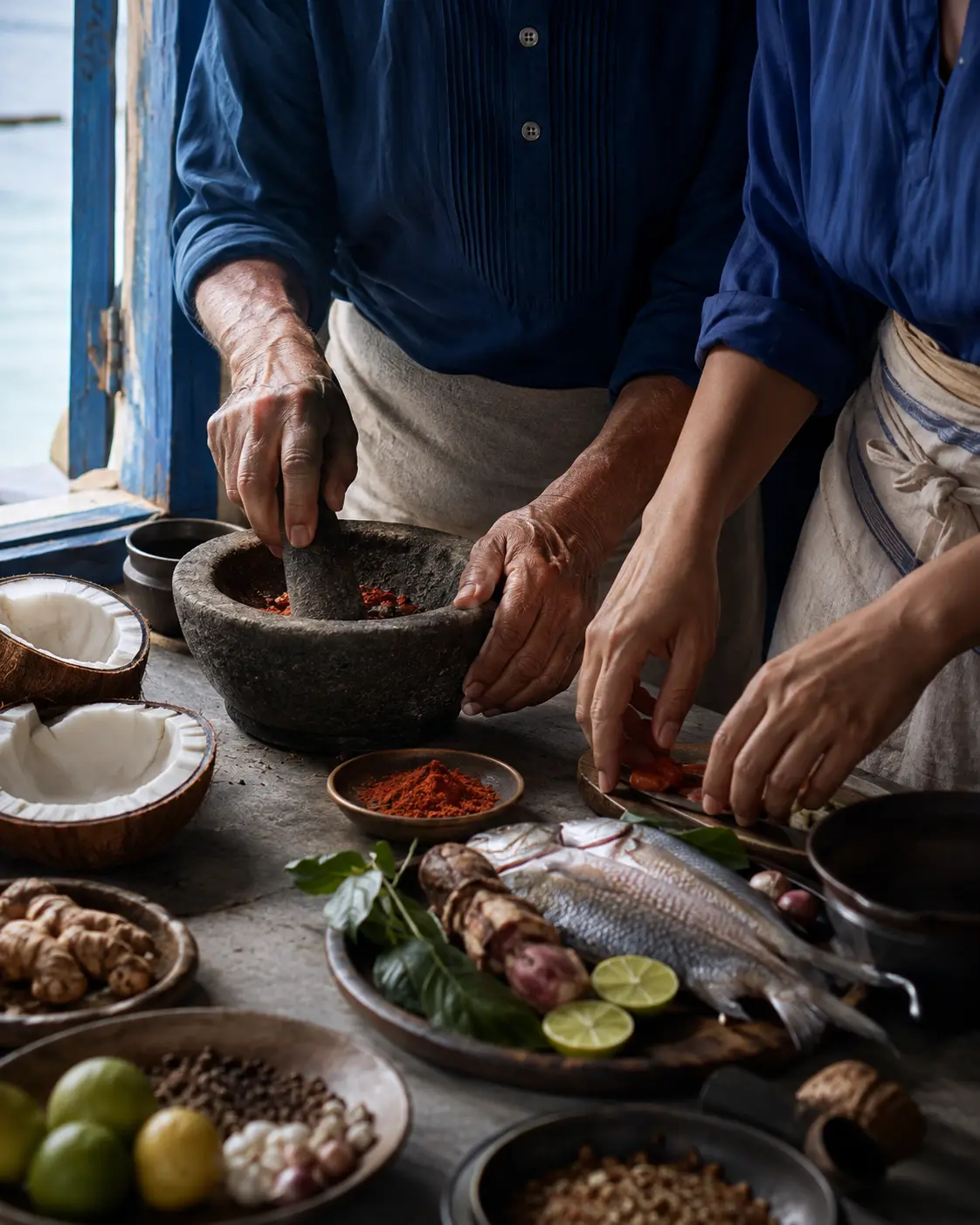
The first keeper may never enter the restaurant
From a fish market in Busan to a smokehouse on the West African coast, the character of a dish may begin with the fisher who distinguishes similar species, the vendor who knows which catch can travel, the salt-maker, seaweed gatherer, coconut grower or person who ferments food for another season.
When these roles disappear, a written recipe can remain while its flavour narrows. Ingredient knowledge is cultural knowledge: when to harvest, what can substitute and how currents, rainfall or heat change the day’s cooking.
Home kitchens carry the unwritten version
Many techniques are measured by eye, hand, smell and sound. Lime is adjusted in Peruvian ceviche; dashi changes with its ingredients in Japan; kokum or tamarind shifts with the catch in India; island cooks read coconut, smoke and starch through touch. These examples are not one tradition—they show how living food knowledge resists a universal formula.
Restaurants can help by naming regional sources, crediting collaborators and paying for knowledge. They can harm by presenting one chef’s version as the only authentic one. UNESCO’s Intangible Cultural Heritage framework is useful here: heritage is continually recreated by communities, not sealed away from change.
What a respectful diner can do
Ask what is local today and what the kitchen is proud to cook, rather than demanding the most famous dish in every season. Learn the local name of a species or preparation.
Preservation does not refuse change. It asks that change remains legible: who changed the dish, what was replaced and whether the people behind it share in its value.
- Order beyond the single famous dish.
- Treat seasonal absence as knowledge.
- Ask before photographing people at work.
- Credit the cook or source when sharing.
- Buy directly only through a welcomed channel.
Before you decide
Keep these five things with you.
- 01Notice who is credited
- 02Ask what is local and seasonal
- 03Respect household variation
- 04Pay for knowledge and products fairly
- 05Share names accurately
How this story earns trust
Sources, method and relationship—visible.
Each reference is tagged by the geography and authority of the source—not by the reader’s location. A country tag means the evidence is country-specific; it is never presented as a global rule.
Method
This article maps roles and respectful reader behaviour. It does not claim interviews or fieldwork. Future named profiles will identify the person, place and interview date.
Commercial relationship
Independent editorial. No restaurant, tourism board or food brand paid for inclusion. Official tourism pages provide geographic context, not endorsement.
Correction or improvement
Found a mistake, a missing perspective or a source we should review? Send it to the editorial desk ↗
- 01Browse the Intangible Cultural Heritage Lists ↗
UNESCO. Global register of living practices, including foodways and community knowledge.
- 02Gastronomy and wine tourism ↗
UN Tourism. Global policy and destination context for food-led travel.
- 03Ceviche: knowledge, practices and meanings ↗
UNESCO. A country-specific example of a living coastal food practice.
- 04Goan Cuisine: A Confluence of Cultures ↗
Incredible India, Ministry of Tourism. One regional example of layered coastal food influences.
If this made you pause, pass the blue forward.
The people keeping the world’s coastal kitchens alive
Ready to share
Made for personal and editorial sharing with Eight June attribution. Facts are shortened for the card; the article carries the full context, method and sources.
Questions readers ask next
Three sourced answers
to keep close.
What is the shortest answer?
Fishers, growers, market sellers, home cooks, processors, caterers, restaurant teams, writers and diners all preserve cuisine. It lasts when knowledge, credit and value continue to move through the community.
Which evidence is carrying the answer?
The evidence trail names Browse the Intangible Cultural Heritage Lists, Gastronomy and wine tourism, Ceviche: knowledge, practices and meanings, Goan Cuisine: A Confluence of Cultures. Open those records for their exact scope, geography, definitions and update dates.
What should I carry into the decision?
The page’s checklist highlights these points: Notice who is credited; Ask what is local and seasonal; Respect household variation; Pay for knowledge and products fairly. Use the linked sources to confirm any detail that changes by place, provider or date. The editorial information on this page was last reviewed on 1 September 2026. Time-sensitive conditions, prices, rules and availability should still be confirmed at the linked source on the day they matter.