What · Pulse
What the Mangrove Breakthrough’s 2030 target actually means
The Mangrove Breakthrough is mobilising a stated US$4 billion to secure the future of 15 million hectares of mangroves by 2030, combining protection, restoration, finance, policy and community-led delivery.
The target combines area and finance
The Mangrove Breakthrough states that it is mobilising US$4 billion to secure the future of 15 million hectares of mangroves by 2030. Its FAQ explains the area ambition through halting loss, increasing protection and restoring at least part of recent degradation.
Those verbs are not interchangeable. Protection keeps existing ecosystems from being lost; restoration tries to recover degraded systems; finance enables work but is not itself an ecological result.
The published pathway is larger than tree planting
The initiative lists finance, community, policy, project pipelines and outreach as action pathways. It also describes mangroves as biodiversity habitat, coastal resilience infrastructure, livelihood support and blue-carbon ecosystems.
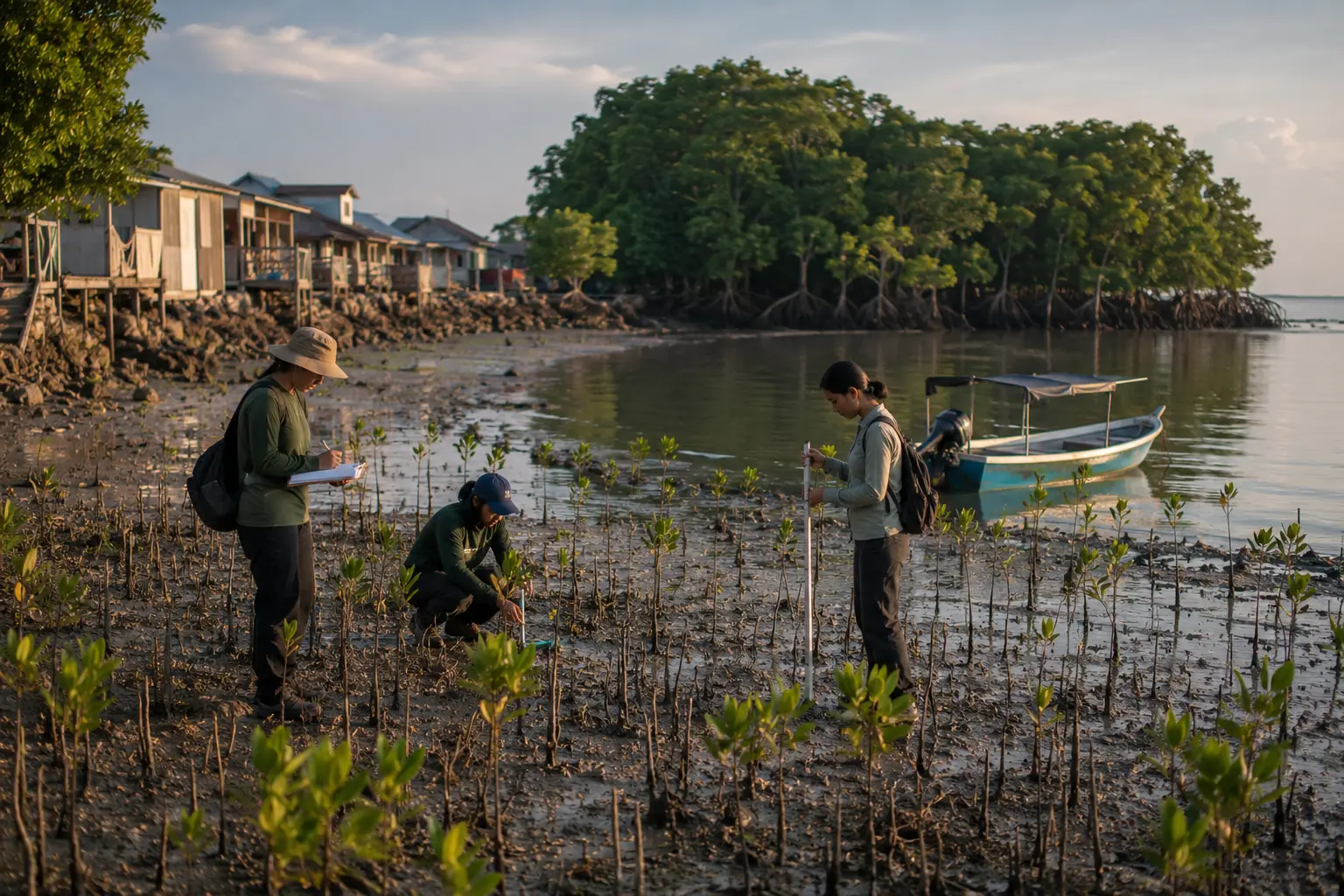
A credible reading therefore asks which outcome a project is claiming. Seedlings in the ground do not establish long-term survival, tenure security, biodiversity benefit or community consent.
- Name the protection or restoration objective
- Define the hectares and baseline
- Identify who holds rights and leadership
- Publish finance and benefit-sharing terms
- Track survival and ecological condition over time
Present position: endorsements are not completed hectares
The current official site reports participation from community implementers, financial institutions and governments. Those counts show coalition building; they should not be converted into completed restoration without project-level evidence.
The initiative’s 2025 material describes work to connect the 2030 goal with investment and delivery. Readers should distinguish announced finance, committed finance, deployed finance and independently measured outcomes.
The opportunity is a higher bar for nature finance
The published principles call for biodiversity safeguards, strong information, community priority, local fit, sustainability and high-integrity capital. These provide questions that funders, governments and communities can take into a specific project.
Eight June’s forward-looking interpretation is that the target will be useful if it makes those conditions auditable rather than allowing hectare totals to erase quality. The 2030 ambition is documented; success is not yet a completed fact.
Before you decide
Keep these five things with you.
- 01Separate protection from restoration
- 02Check the baseline and hectare definition
- 03Follow money from pledge to deployment
- 04Look for community rights and benefit sharing
- 05Track ecological outcomes beyond planting day
How this story earns trust
Sources, method and relationship—visible.
Each reference is tagged by the geography and authority of the source. Country-specific evidence is never presented as a global rule.
Method
This Pulse article uses the Mangrove Breakthrough’s current mission, FAQ and published principles. It reports the 2030 ambition as a target, not an achieved outcome.
Commercial relationship
Independent editorial. The Mangrove Breakthrough, endorsers, funders and project developers did not pay for inclusion.
Correction or improvement
Found a mistake, a missing perspective or a source we should review? Send it to the editorial desk ↗
- 01Mangrove Breakthrough · Mission and action pathways ↗
Mangrove Breakthrough. Current target, finance ambition, pathways and principles.
- 02Mangrove Breakthrough FAQ ↗
Mangrove Breakthrough. Explains protection, restoration and 2030 goal components.
- 03Scaling up with quality at the core ↗
Mangrove Breakthrough. Current framing for tracking quality, finance and the 2030 target.
If this made you pause, pass the blue forward.
What the Mangrove Breakthrough’s 2030 target actually means
Ready to share
Made for personal and editorial sharing with Eight June attribution. Facts are shortened for the card; the article carries the full context, method and sources.
Useful questions
Quick answers,
kept specific.
Is 15 million hectares a completed result?
No. It is the initiative’s stated 2030 ambition.
Does the target mean planting alone?
No. The published framework includes halting loss, protection, restoration, finance, policy and community-led delivery.
What should a project disclose?
Baseline, hectare definition, rights and leadership, finance status, safeguards, survival and long-term ecological outcomes.