Why · Essence
Why mangroves belong in the travel story
Mangroves rarely receive the visual attention given to beaches, yet these salt-tolerant forests can be among a coast’s most consequential places—nurseries, storm buffers, carbon stores and working landscapes at once.
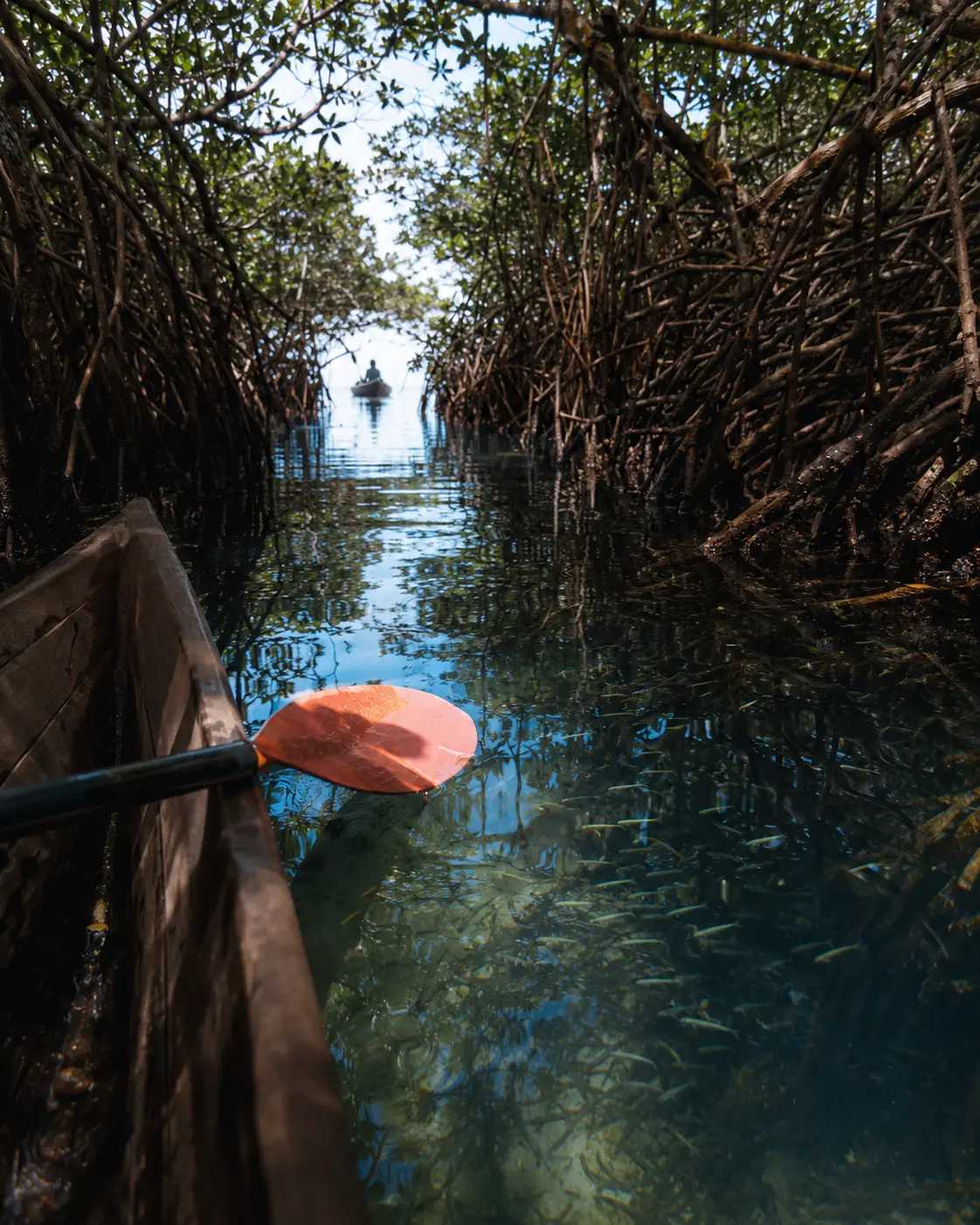
A forest designed for the tide
Mangroves live in intertidal zones where salt, mud, roots and moving water meet. Their root systems slow water and trap sediment while creating shelter for fish, crustaceans, birds and other wildlife.
UNEP notes that mangroves occupy less than one per cent of global tropical forest cover yet provide important services to people living near coasts.
Restoration is more than planting
A row of seedlings is not automatically a restored ecosystem. Hydrology, elevation, species, sediment movement, land rights and long-term community care determine whether a project has a realistic future.
A locally led canoe route, boardwalk or interpretation centre can reveal the ecosystem without turning sensitive roots and wildlife into a crowd corridor.
- Prefer locally led tours.
- Stay inside marked channels and paths.
- Do not collect seedlings, shells or wildlife.
- Ask how restoration success is measured after planting.
What to notice
Listen for the change in sound, watch how roots hold small territories of water, and notice the livelihoods around the forest—fishing, honey, guiding, craft or restoration work.
The quieter question is whether tourism helps keep the mangrove standing. Choose experiences that can explain their local benefit plainly.
Before you decide
Keep these five things with you.
- 01Choose community-led access
- 02Respect tides and marked routes
- 03Avoid wildlife disturbance
- 04Ask about long-term monitoring
- 05Leave roots and sediment untouched
How this story earns trust
Sources, method and relationship—visible.
Each reference is tagged by the geography and authority of the source—not by the reader’s location. A country tag means the evidence is country-specific; it is never presented as a global rule.
Method
The article combines UNEP’s global overview with dated restoration examples. It does not rate individual projects or carbon claims.
Commercial relationship
Independent editorial. No tour, conservation project or carbon programme paid for inclusion.
Correction or improvement
Found a mistake, a missing perspective or a source we should review? Send it to the editorial desk ↗
- 01Mangrove forests ↗
United Nations Environment Programme. Global overview of mangrove benefits, pressures and restoration.
- 02Mangroves are making a comeback. Here’s what’s working ↗
United Nations Environment Programme. 2026 examples of science-led, community-based conservation and restoration.
If this made you pause, pass the blue forward.
Why mangroves belong in the travel story
Ready to share
Made for personal and editorial sharing with Eight June attribution. Facts are shortened for the card; the article carries the full context, method and sources.
Questions readers ask next
Three sourced answers
to keep close.
What is the shortest answer?
Mangroves matter because they connect land and sea: sheltering young marine life, improving water quality, storing carbon and helping reduce erosion and storm impacts while supporting coastal livelihoods.
Which evidence is carrying the answer?
The evidence trail names Mangrove forests, Mangroves are making a comeback. Here’s what’s working. Open those records for their exact scope, geography, definitions and update dates.
What should I carry into the decision?
The page’s checklist highlights these points: Choose community-led access; Respect tides and marked routes; Avoid wildlife disturbance; Ask about long-term monitoring. Use the linked sources to confirm any detail that changes by place, provider or date. The editorial information on this page was last reviewed on 1 September 2026. Time-sensitive conditions, prices, rules and availability should still be confirmed at the linked source on the day they matter.