Who · Voices
The women who hold small-scale fisheries together
The boat is the most photographed part of a fishery. Much of the system’s continuity may sit elsewhere—with women processing, trading, repairing, financing, organizing and feeding communities before the catch reaches a formal market.
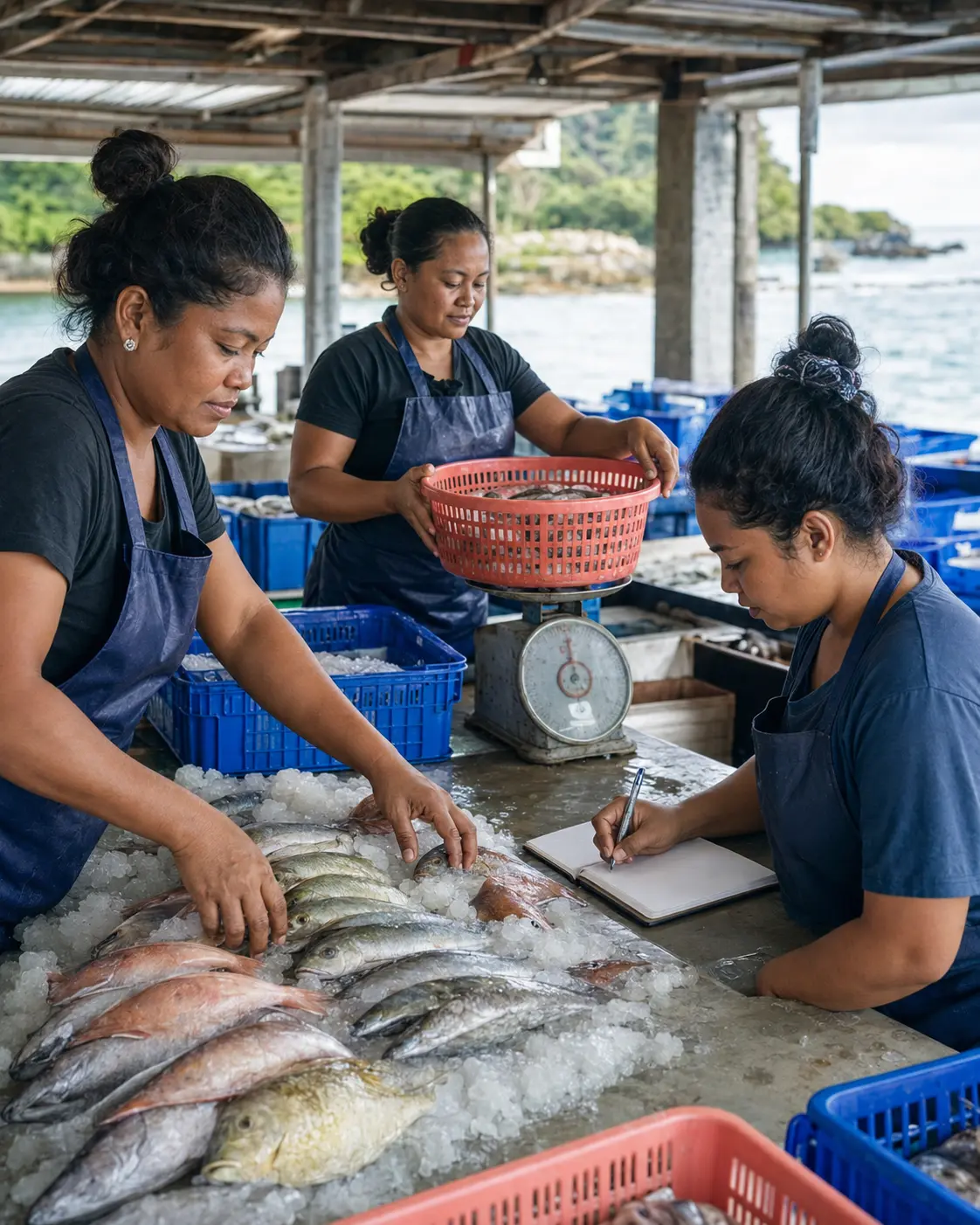
Visibility changes value
FAO’s current gender guidance estimates that women account for about 56 million jobs across small-scale capture-fisheries supply chains. Their work is often informal or undercounted.
That invisibility affects access to credit, equipment, cold storage, training, social protection and the tables where fisheries rules are decided.
How to tell the story without taking it
A market profile should name the person’s role and business, not reduce her to colourful background. Ask permission for photographs and clarify where the story will appear.
Avoid the lone-hero narrative. Fisheries are systems of households, cooperatives, traders, transporters, processors and managers.
- Name the actual role.
- Ask before photographing.
- Credit knowledge and translation.
- Include decision-making, not only labour.
What a visitor can notice
Look beyond the landing point: auction, drying yard, smoking house, processing room, cooperative shop and local kitchen. Ask who sets the price and who carries risk when weather or catch fails.
Spend where women-led enterprises are visible and verified, without assuming every community wants tourism inside its workplace.
Before you decide
Keep these five things with you.
- 01See the whole value chain
- 02Ask permission
- 03Name work accurately
- 04Pay for commissioned knowledge
- 05Support verified local enterprises
How this story earns trust
Sources, method and relationship—visible.
Each reference is tagged by the geography and authority of the source—not by the reader’s location. A country tag means the evidence is country-specific; it is never presented as a global rule.
Method
This is a sourced structural profile, not an invented interview. No quotation or personal biography is attributed without a named primary source.
Commercial relationship
Independent editorial. No cooperative, market or development programme paid for inclusion.
Correction or improvement
Found a mistake, a missing perspective or a source we should review? Send it to the editorial desk ↗
- 01Gender equity and equality ↗
Food and Agriculture Organization of the United Nations. Current global estimates and policy context for women in small-scale fisheries.
- 02Small-scale fisheries ↗
Food and Agriculture Organization of the United Nations. Overview of livelihoods, food security and participation.
If this made you pause, pass the blue forward.
The women who hold small-scale fisheries together
Ready to share
Made for personal and editorial sharing with Eight June attribution. Facts are shortened for the card; the article carries the full context, method and sources.
Questions readers ask next
Three sourced answers
to keep close.
What is the shortest answer?
FAO estimates women make up 47% of people involved in small-scale capture fisheries, much of it in processing and trade. Seeing the whole value chain changes who receives recognition, training, finance and decision-making power.
Which evidence is carrying the answer?
The evidence trail names Gender equity and equality, Small-scale fisheries. Open those records for their exact scope, geography, definitions and update dates.
What should I carry into the decision?
The page’s checklist highlights these points: See the whole value chain; Ask permission; Name work accurately; Pay for commissioned knowledge. Use the linked sources to confirm any detail that changes by place, provider or date. The editorial information on this page was last reviewed on 1 September 2026. Time-sensitive conditions, prices, rules and availability should still be confirmed at the linked source on the day they matter.